
01Free UK Template · Excel and PDF
COSHH assessment template UK: free form with worked example, risk scores and LEV checks
Free COSHH assessment template in Excel and PDF: substances and process dust or fume, exposure, controls, a worked example and a 14-month LEV check log.
What the COSHH Regulations require
An employer must not carry out work that could expose employees to a substance hazardous to health until it has made a suitable and sufficient assessment of the risk and of the steps needed to meet the regulations, and has put those steps in place. That is regulation 6 of the Control of Substances Hazardous to Health Regulations 2002 (SI 2002/2677), which extends to England, Wales and Scotland. Northern Ireland has the same duty in regulation 6 of the COSHH Regulations (Northern Ireland) 2003 (SR 2003/34).
Regulation 6(2) lists what the assessment must consider, including the hazardous properties of the substance, information from the supplier such as the safety data sheet, the type, level and duration of exposure, the circumstances and amount of the work, any workplace exposure limit, the effect of the control measures, the results of health surveillance and monitoring, and whether the work involves more than one substance. The assessment must be reviewed regularly and at once if there is reason to suspect it is no longer valid, the work changes significantly or the results of exposure monitoring show a review is needed (regulation 6(3)).
With 5 or more employees you must record the significant findings as soon as practicable and the steps you have taken to meet regulation 7 (prevention or control of exposure).
HSE's steps and how the template follows them
| HSE step | Template column |
|---|---|
| Find the hazardous substances, including dust, fume and vapour the work creates (wood dust, silica, welding fume) | Substance or process; SDS dated; hazards from SDS section 2 and any workplace exposure limit |
| Decide who could be harmed and how | Task, amount and how used; route of exposure; who is exposed, how long and how often |
| Evaluate the risks and decide on precautions | Controls in place; likelihood × severity score before further action |
| Prevent or adequately control exposure: eliminate or substitute, change the process, enclose or extract, safe systems of work, and personal protective equipment as the last resort | Further action needed; who, by when; done |
| Make sure controls are used and maintained; monitor and provide health surveillance where needed | Health surveillance flag; the LEV and checks sheet with next due dates |
| Record and review | Assessment date, planned review date and the open-actions count |
The score of likelihood times severity, from 1 to 25, is a way to rank the rows; HSE does not prescribe a scoring method. What the law asks is that exposure is prevented or adequately controlled.
Worked example: a small joinery
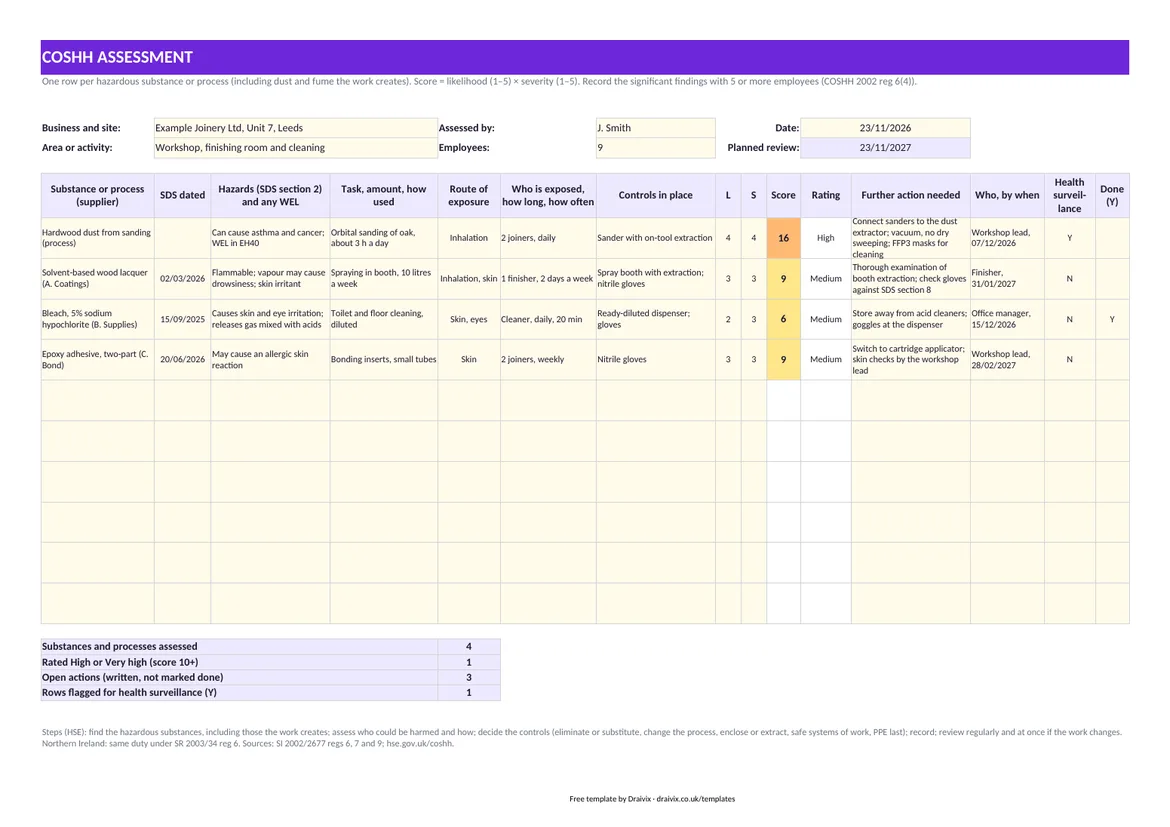
Example Joinery Ltd has 9 employees, so the findings must be written down. The filled-in sample in the download has four rows:
| Substance or process | Exposure | Score before action | Further action |
|---|---|---|---|
| Hardwood dust from sanding (process) | Inhalation, 2 joiners daily | 16 (High) | Connect sanders to the extractor, vacuum instead of sweeping, FFP3 masks for cleaning, health surveillance flagged |
| Solvent-based lacquer in a spray booth | Inhalation and skin, 2 days a week | 9 (Medium) | Thorough examination of the booth extraction, which the LEV sheet shows as overdue |
| Bleach for cleaning | Skin and eyes, daily | 6 (Medium) | Store away from acid cleaners, goggles at the dispenser (done) |
| Two-part epoxy adhesive | Skin, weekly | 9 (Medium) | Cartridge applicator, skin checks |
HSE states that wood dust can cause asthma, that hardwood dust can cause cancer, particularly of the nose, and that hardwood dust has a workplace exposure limit of 3 mg/m³ (8-hour average). The summary under the table counts 4 rows, 1 rated High, 3 open actions and 1 row flagged for health surveillance; the LEV sheet counts 1 overdue examination. Every count is a live formula.
Local exhaust ventilation and other checks
- LEV: a thorough examination and test at least once every 14 months, or more often for the processes listed in Schedule 4 of the regulations (regulation 9(2)).
- Respiratory protective equipment other than disposable masks: thorough examination and, where appropriate, testing at suitable intervals (regulation 9(3)).
- Records: keep a record of examinations, tests and resulting repairs, or a summary, for at least 5 years (regulation 9(4)).
- PPE: store it in a defined place, check it at suitable intervals and repair or replace it when defective (regulation 9(5)).
The second sheet of the template lists each piece of extraction with its last examination, the interval and a formula for the next due date and status against the assessment date.
COSHH, general risk assessments and records in Draivix
A COSHH assessment sits alongside the general risk assessment template and the fire risk assessment template. Draivix does not write or certify COSHH assessments. Asset management records inspections with the outcome, certificate number and next inspection date, which suits LEV examinations, employee records track training and medical check-ups with due dates in the calendar, and the documents library stores safety data sheets and the signed assessment with a publication and expiry date.
Sources and legal basis
- Control of Substances Hazardous to Health Regulations 2002, regulation 6
- Control of Substances Hazardous to Health Regulations 2002, regulation 9
- COSHH Regulations (Northern Ireland) 2003, regulation 6
- HSE: COSHH assessment, identifying hazards and assessing risks
- HSE: Wood dust
Facts checked:
02Frequently Asked Questions
What is a COSHH assessment?
The assessment regulation 6 of the COSHH Regulations 2002 requires before work that could expose employees to hazardous substances: what the substances are, who is exposed and how, and what controls are needed.
Is a COSHH assessment a legal requirement?
Yes, where work could expose employees to substances hazardous to health. Employers with 5 or more employees must also record the significant findings.
Is a safety data sheet the same as a COSHH assessment?
No. The safety data sheet is the supplier's information about the product. The assessment applies it to your work: how much you use, how, by whom and with what controls.
How often should a COSHH assessment be reviewed?
Regularly, and at once if there is reason to suspect it is no longer valid, the work changes significantly, or exposure monitoring shows it is necessary. The regulations set no fixed interval.
How often must LEV be tested?
A thorough examination and test at least every 14 months, or more often for the processes in Schedule 4, with records kept for at least 5 years.
Does COSHH cover dust and fumes?
Yes. HSE lists dust, fume and vapour the work creates, such as wood dust, silica and welding fume, as substances to assess alongside the products you buy.
03More Free UK Tools
Related UK Calculators, Templates & Guides
- Expenses claim form template UK: free Excel and PDFFree employee expenses claim form in Excel and PDF: receipted costs, mileage at 55p and 25p for 2026/27, HMRC benchmark meal allowances and live totals.Open
- Autumn Budget 2026: what changes for employersWhen was the Budget 2026 and what changes for employers and small businesses: dates from January 2027 to 2029, figures and each measure's status in Parliament.Open
- Business rates calculator 2026/27 (England, Wales, Scotland)Estimate your 2026/27 business rates bill in England, Wales or Scotland from the rateable value, with the right multiplier and small business relief by nation.Open
- EICR: electrical installation condition report rulesWhat an EICR is, how often landlords need one in England, Wales, Scotland and Northern Ireland, the codes, the deadlines and a free register for every property.Open
Let’s start together
Tell us how your business works.
We will show you what a system that takes over part of that work could look like.
Book a consultation