
01Free UK Template · Excel and PDF
Autumn Budget 2026 for employers and small businesses: what changes when, and what is law yet
When was the Budget 2026 and what changes for employers and small businesses: dates from January 2027 to 2029, figures and each measure's status in Parliament.
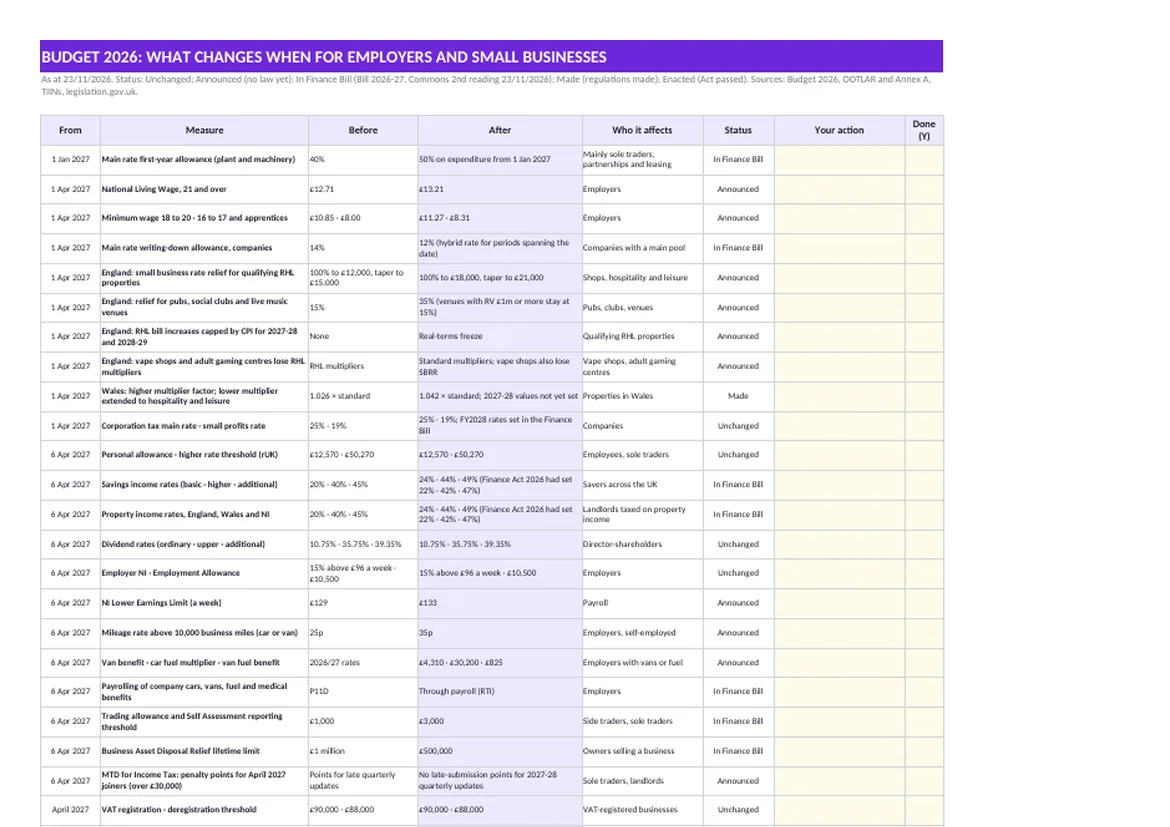
When the Budget was, and how to read what it changed
The Chancellor delivered Budget 2026 on Wednesday 28 October 2026. Most of its tax changes start in April 2027, a few on 1 January 2027 and the largest administrative changes in 2028 and 2029. A Budget announcement is not law: tax changes go into the Finance Bill, which Parliament still has to pass, and rates such as the minimum wage, mileage and benefit charges are set by regulations later. This page lists only what affects an employer or a small company, with the start date and where each measure stands on 23 November 2026.
- Announced: in the Budget document or the overview of tax legislation and rates (OOTLAR), with no legislation yet; regulations or a later Finance Bill are to follow.
- In the Finance Bill: a clause in Finance Bill 2026-27, introduced in the Commons on 3 November 2026, which had its second reading on 23 November 2026 and goes to a committee of the whole House on 30 November and 1 December 2026. Clauses can still be amended.
- Made: regulations already signed. Enacted: an Act with Royal Assent.
- Unchanged: a rate the Budget confirmed for 2027/28.
Scotland sets its own income tax bands and business rates, and Wales and Northern Ireland set their own business rates, so the England measures below on business rates do not apply there. For the employer pay and statutory payment figures in more detail, see April 2027 changes for employers.
What changes when: the table
| From | Measure | Change | Status on 23/11/2026 |
|---|---|---|---|
| 1 Jan 2027 | Main rate first-year allowance on plant and machinery | 40% → 50% of expenditure from that date | In Finance Bill |
| 1 Apr 2027 | National Living Wage (21 and over) | £12.71 → £13.21 an hour; 18 to 20 £11.27; under 18 and apprentices £8.31 | Announced; regulations to follow |
| 1 Apr 2027 | Main rate writing-down allowance, companies | 14% → 12%; hybrid rate for periods spanning the date | In Finance Bill |
| 1 Apr 2027 | England: small business rate relief for retail, hospitality and leisure | Full relief up to £18,000 rateable value, tapering to £21,000 | Announced |
| 1 Apr 2027 | England: pubs, social clubs and live music venues | Relief 15% → 35%; venues of £1 million or more excluded | Announced |
| 1 Apr 2027 | Wales: higher multiplier factor; lower multiplier extended to listed hospitality and leisure | Factor 1.026 → 1.042; values for 2027-28 not yet set | Made (SI 2026/133 (W)) |
| 6 Apr 2027 | Employer NI, thresholds and Employment Allowance | 15% above £96 a week, UEL £967, allowance £10,500 | Unchanged |
| 6 Apr 2027 | NI Lower Earnings Limit | £129 → £133 a week | Announced; regulations early 2027 |
| 6 Apr 2027 | Mileage rate above 10,000 business miles | 25p → 35p | Announced; regulations to follow |
| 6 Apr 2027 | Payrolling company cars, vans, fuel and medical benefits | Through payroll instead of P11D | In Finance Bill |
| 6 Apr 2027 | Van benefit, car fuel multiplier, van fuel | £4,310, £30,200, £825 | Announced; regulations to follow |
| 6 Apr 2027 | Trading allowance and Self Assessment reporting threshold | £1,000 → £3,000 | In Finance Bill |
| 6 Apr 2027 | Savings rates; property income rates in England, Wales and NI | 20%, 40%, 45% → 24%, 44%, 49% (Finance Act 2026 had already set 22%, 42%, 47% for 2027/28) | In Finance Bill |
| 6 Apr 2027 | Business Asset Disposal Relief lifetime limit | £1 million → £500,000 | In Finance Bill |
| 6 Apr 2027 | Making Tax Digital for Income Tax, April 2027 joiners | No late-submission penalty points for 2027-28 quarterly updates | Announced |
| 1 Jul 2027 | Fuel duty on petrol and diesel | 5p cut ends 30 Jun 2027; 52.95p → 60.59p a litre | Announced |
| Oct 2027 | Online marketplaces | Platform collects VAT on sales by UK VAT-registered sellers and other UK businesses above a per-platform sales threshold; date and threshold by regulations | In Finance Bill |
| 6 Apr 2028 | Payrolling most other benefits in kind | Not employment-related loans or living accommodation | In Finance Bill |
| 6 Apr 2028 | Benchmark scale rates for travel meals | £20 over 5 hours, £60 over 10 hours, £75 over 24 hours | Announced |
| 6 Apr 2028 | £2,500 Self Assessment limit for employment expenses | Removed | Announced |
| 1 Apr 2029 | VAT e-invoicing | VAT invoices in a specified electronic format | Enabling powers in Finance Bill |
| Apr 2029 | VAT and PAYE return liabilities | Paid by Direct Debit | Announced |
| 6 Apr 2029 | Salary-sacrificed pension contributions | Class 1 NI on contributions above a £2,000 yearly limit | Enacted (Act 2026 c. 15); regulations not yet made |
The free Excel timeline has every line with the rate before and after, who it affects, its status and a column for your own action and a done mark; it counts the measures by status and the actions still open. The PDF is the same table for a board pack.
Payroll: what stays and what moves
Employer National Insurance stays at 15% above the secondary threshold of £96 a week, with the Employment Allowance at £10,500, the figures the National Insurance Contributions (Secondary Class 1 Contributions) Act 2025 set from 6 April 2025; the employee primary threshold (£242 a week) and the upper limits (£967) are frozen. The only threshold that moves is the Lower Earnings Limit, from £129 to £133 a week from 6 April 2027, which the OOTLAR says will be set by secondary legislation in early 2027. The personal allowance stays at £12,570 and the additional rate threshold at £125,140; the personal allowance and the basic rate limit are frozen to 2030/31 by section 5 of the Finance Act 2021 as extended by section 10 of the Finance Act 2026. Scotland's own bands are set in the Scottish Budget.
- Benefits through payroll: under the Finance Bill, from 6 April 2027 company cars, vans, car and van fuel and medical benefits are to be payrolled, with the rest following on 6 April 2028 except employment-related loans and living accommodation.
- Company cars: the percentage for electric cars rises from 4% in 2026/27 to 5% in 2027/28, 7% in 2028/29 and 9% in 2029/30, as already legislated (Finance Act 2025); the Finance Bill would take it to 10% in 2030/31; see the company car tax calculator.
- Mileage: the rate above 10,000 business miles goes from 25p to 35p, which also moves the NI disregard; see the mileage allowance calculator.
- Salary sacrifice into pensions: the National Insurance Contributions (Employer Pensions Contributions) Act 2026 received Royal Assent on 29 April 2026 and has effect from the 2029-30 tax year; the regulations that set the £2,000 limit are not made yet. Model it with the salary sacrifice calculator.
Small companies and sole traders
- Corporation tax: 25% main rate and 19% small profits rate, with the £50,000 and £250,000 limits and marginal relief, unchanged; the Finance Bill also sets them for the financial year 2028. See the corporation tax calculator.
- Capital allowances (Finance Bill): the main rate first-year allowance rises from 40% to 50% for expenditure from 1 January 2027 and the main writing-down allowance falls from 14% to 12% from 1 April 2027 for companies and 6 April 2027 for income tax. The £1 million Annual Investment Allowance, 100% full expensing for companies and the 6% special rate are unchanged. HMRC's note says the 50% allowance mainly helps unincorporated businesses and leasing.
- Trading allowance (Finance Bill): £1,000 to £3,000 from 6 April 2027, with the Self Assessment reporting threshold for trading income moving with it; see register for Self Assessment.
- Dividends: rates stay at 10.75%, 35.75% and 39.35% with a £500 allowance; savings income and, outside Scotland, property income each go up 4 points.
- Selling the business (Finance Bill): the Business Asset Disposal Relief lifetime limit halves to £500,000 for disposals from 6 April 2027.
- Making Tax Digital for Income Tax: sole traders and landlords with qualifying income over £30,000 join from 6 April 2027, and the Budget says they get no late-submission penalty points on their 2027-28 quarterly updates; see MTD for Income Tax 2027.
VAT, business rates and fuel
The VAT registration threshold stays at £90,000 and deregistration at £88,000. From October 2027, under the Finance Bill, online marketplaces are to collect VAT on sales by UK VAT-registered sellers and other UK businesses above a per-platform sales threshold, not on personal, second-hand or business-to-business sales, with the threshold and start date set by regulations; from April 2027 the reverse charge on cross-border services is limited to VAT-registered customers. From 1 April 2029 VAT invoices must be issued in a specified electronic format; the Finance Bill takes the powers and the detail follows in regulations, with the full design promised by April 2028. See e-invoicing from 2029.
In England, the Budget raises small business rate relief for qualifying retail, hospitality and leisure properties to 100% up to £18,000 rateable value from 1 April 2027, tapering to £21,000; lifts pubs and live music relief from 15% to 35%; caps those bills by CPI in 2027-28 and 2028-29; and moves vape shops and adult gaming centres off the lower multipliers. These are announcements; check this year's bill with the business rates calculator. The 5p fuel duty cut lasts until 30 June 2027, after which the rate goes from 52.95p to 60.59p a litre.
Turning the Budget into tasks in Draivix
Draivix does not calculate tax, run payroll or file with HMRC. What it does is prepare inputs and keep records: payroll inputs give each employee a monthly row with hours from attendance, base pay and bonuses for the payroll accountant, and employee records hold each person's pay type, so the hourly-paid staff affected on 1 April 2027 are one filter away. Purchase invoices for plant and vans pass through received invoices and approval with cost centres, which helps your accountant separate capital spend before and after 1 January 2027.
Sources and legal basis
- HM Treasury: Budget 2026 (28 October 2026)
- HM Treasury: Budget 2026 overview of tax legislation and rates (OOTLAR)
- HM Treasury: Budget 2026 overview of tax legislation and rates, Annex A
- UK Parliament: Finance Bill 2026-27, stages
- HMRC: Capital allowances, main rate writing-down allowance and first-year allowance (tax information and impact note)
- HMRC: Income Tax, increasing the trading allowance (tax information and impact note)
- HMRC: Changes to reporting of benefits in kind from April 2027
- legislation.gov.uk: National Insurance Contributions (Employer Pensions Contributions) Act 2026, section 1
- legislation.gov.uk: Non-Domestic Rating (Description and Value of Differential Multipliers) (Amendment) (Wales) Regulations 2026, SI 2026/133
- Low Pay Commission: recommendations take the National Living Wage to £13.21 (28 October 2026)
Facts checked:
02Frequently Asked Questions
When is the Budget 2026?
The Chancellor delivered Budget 2026 on Wednesday 28 October 2026. The Finance Bill that carries its tax changes had its Commons second reading on 23 November 2026.
Is employer National Insurance going up in 2027?
No. The rate stays at 15% above £96 a week and the Employment Allowance at £10,500 for 2027/28; only the Lower Earnings Limit rises, to £133 a week.
Is the Budget 2026 law yet?
Not all of it. As at 23 November 2026 the Finance Bill is still in the Commons, the minimum wage, mileage and Lower Earnings Limit need regulations, and some measures such as Direct Debit for VAT and PAYE are only announced.
What did the Budget change for small businesses?
A £3,000 trading allowance from April 2027, a 50% first-year allowance on main rate plant from January 2027 with a 12% writing-down allowance, a halved Business Asset Disposal Relief limit, and in England more rate relief for shops, pubs and leisure.
When does the salary sacrifice pension cap start?
From the 2029-30 tax year. The Act passed in April 2026; the regulations setting the £2,000 limit have not been made.
When does the National Living Wage go up?
On 1 April 2027, to £13.21 an hour for workers aged 21 and over.
03More Free UK Tools
Related UK Calculators, Templates & Guides
- Business rates calculator 2026/27 (England, Wales, Scotland)Estimate your 2026/27 business rates bill in England, Wales or Scotland from the rateable value, with the right multiplier and small business relief by nation.Open
- EICR: electrical installation condition report rulesWhat an EICR is, how often landlords need one in England, Wales, Scotland and Northern Ireland, the codes, the deadlines and a free register for every property.Open
- Xero Alternative for UK Companies: Fact ComparisonXero and Draivix side by side in a comparison table: MTD, payroll, stock, manufacturing, CRM, hosting and licences, each fact linked to the vendor's own page.Open
- QuickBooks Alternative UK: Fact Comparison TableQuickBooks Online and Draivix in a comparison table: HMRC filing, payroll add-on, stock, projects, AI, hosting and plans, sourced from Intuit's UK pages.Open
Let’s start together
Tell us how your business works.
We will show you what a system that takes over part of that work could look like.
Book a consultation