
01Free UK Online Calculator & Excel
HMRC mileage allowance calculator 2026/27: 55p a mile, 25p after 10,000 and 35p announced for April 2027
HMRC mileage rates: 55p for the first 10,000 business miles, then 25p (35p announced for April 2027). Tax-free amount, MAR or excess. Free mileage log.
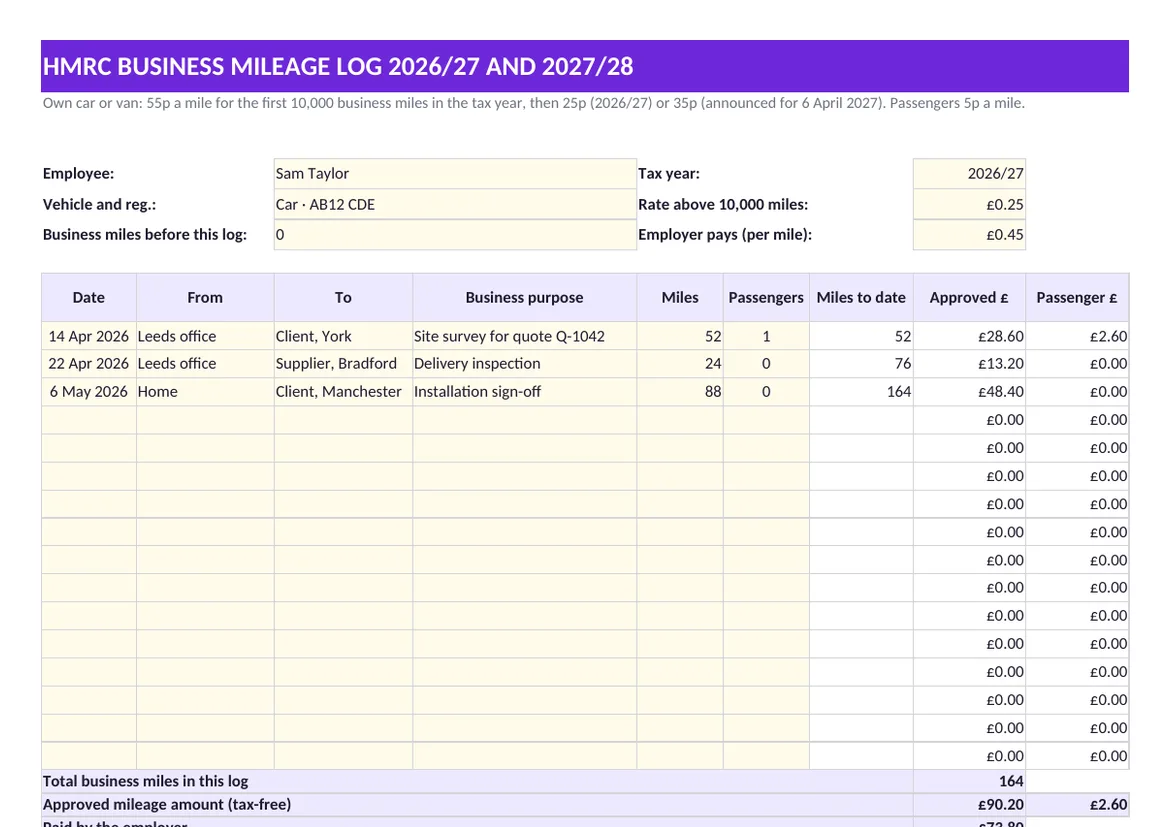
HMRC mileage allowance calculator
Uses HMRC's approved mileage rates for 2026/27 and the 35p higher rate announced at Budget 2026 for 2027/28; passenger payments, company cars and fuel-only payments are outside this calculator.
Approved mileage rates for 2026/27 and 2027/28
From 6 April 2026 employers can pay 55p a mile tax-free for the first 10,000 business miles an employee drives in their own car or van, and 25p a mile after that. Budget 2026 (28 October 2026) announced that the 55p rate is permanent and that the rate above 10,000 miles will rise to 35p from 6 April 2027; HMRC has not yet published a 2027/28 table. Before April 2026 the first-10,000 rate was 45p. These are the Mileage Allowance Payment (MAP) rates for employees' own vehicles, not company cars.
| Vehicle | First 10,000 miles | Above 10,000 (2026/27) | Above 10,000 (2027/28, announced) |
|---|---|---|---|
| Car or van | 55p | 25p | 35p |
| Motorcycle | 24p | 24p | 24p |
| Bicycle | 20p | 20p | 20p |
| Passenger (another employee, same trip) | 5p | 5p | 5p |
For National Insurance in 2026/27 the car and van rate is 55p for every business mile with no 10,000-mile step, and the test is applied per earnings period. Electrically assisted pedal bikes use the bicycle rate; other electric bikes use the motorcycle rate.
Approved amount, MAR and taxable excess
Multiply the employee's business miles for the tax year by the rates above to get the approved amount. HMRC's own example: 12,000 miles in a car gives £6,000 (10,000 × 55p plus 2,000 × 25p).
- Employer pays less than the approved amount: nothing to report. The employee can claim Mileage Allowance Relief (MAR) on the difference.
- Employer pays more: report the excess on a P11D or put it through payroll and deduct tax.
- NI: in 2026/27 payments up to 55p a mile per earnings period are free of Class 1 NI; anything above is added to earnings for NI.
- Passengers: up to 5p a mile is tax and NI free, but there is no MAR if you pay less.
| Example | Approved amount | Employer paid | Result |
|---|---|---|---|
| 12,000 miles in 2026/27, paid 45p | £6,000.00 | £5,400.00 | MAR claim £600.00 |
| 12,000 miles in 2027/28 at the announced rates, paid 55p | £6,200.00 | £6,600.00 | Taxable excess £400.00 |
| 5,000 miles, paid 60p | £2,750.00 | £3,000.00 | Taxable excess £250.00 |
| 3,000 motorcycle miles, paid 24p | £720.00 | £720.00 | Nothing to report |
Advisory fuel rates for company cars
Company cars use different numbers. HMRC's advisory fuel rates reimburse fuel for business trips in a company car, or set what an employee repays for private fuel. HMRC reviews them on 1 March, 1 June, 1 September and 1 December. The rates from 1 December 2026 are:
| Engine size | Petrol | Diesel | LPG |
|---|---|---|---|
| Up to 1400cc (diesel up to 1600cc) | 16p | 16p | 11p |
| 1401 to 2000cc (diesel 1601 to 2000cc) | 19p | 18p | 13p |
| Over 2000cc | 29p | 25p | 20p |
Fully electric company cars: 7p a mile charged at home and 15p a mile at a public charger. Hybrids use the petrol or diesel rate. Do not use advisory fuel rates for an employee's own car; that is what the 55p rate is for.
How to use the calculator and the mileage log
- Pick the vehicle type and the tax year (6 April to 5 April).
- Enter total business miles for the year and the rate your business pays per mile.
- The calculator shows the approved amount and either the MAR the employee can claim or the excess you must report.
- Use the Excel mileage log to record each trip: date, start, destination, purpose, miles and passengers. The sheet keeps a running total, switches to the higher-mileage rate after 10,000 miles and works out MAR or the taxable excess.
Commuting between home and a permanent workplace is not business travel, so leave it out of the log.
Common mistakes
- Still paying 45p as the tax-free limit: from 6 April 2026 the approved rate is 55p.
- Applying the 10,000-mile step per vehicle: HMRC counts all the employee's business miles in the year together, whatever car they use.
- Not checking the rate above 10,000 miles before 6 April 2027: Budget 2026 announced a rise from 25p to 35p.
- Paying advisory fuel rates to employees driving their own cars.
- Including commuting miles, which turns part of the payment into taxable pay.
Business trips in Draivix
Draivix records travel orders against the employee in employee records, and prints them from document templates, so each claim has a trip, a purpose and an approver behind it. Field teams using the mobile app for technicians see the day's visits on a map route, including the return trip.
Sources and legal basis
- GOV.UK: Expenses and benefits, business travel mileage for employees' own vehicles
- HMRC: Travel mileage and fuel rates and allowances
- HMRC: Advisory fuel rates (from 1 December 2026)
- HM Treasury: Budget 2026 (mileage rates)
- HMRC: Rates and thresholds for employers 2026 to 2027
Facts checked:
02Frequently Asked Questions
What is the HMRC mileage rate for 2026/27?
55p a mile for the first 10,000 business miles in a car or van, then 25p a mile. Motorcycles are 24p and bicycles 20p a mile.
Is the mileage rate changing in April 2027?
Budget 2026 (28 October 2026) announced that the 55p rate is permanent and that the rate for miles above 10,000 rises from 25p to 35p from 6 April 2027. Check HMRC's rates table for 2027/28 once it is published.
What if my employer pays less than 55p a mile?
You can claim Mileage Allowance Relief on the difference between the approved amount and what you were paid. At 45p on 12,000 miles in 2026/27 that is £600 of mileage on which you get tax relief.
Can I pay more than the HMRC mileage rate?
Yes, but the excess over the approved amount is taxable. Report it on a P11D or put it through payroll; for NI in 2026/27 anything above 55p a mile in the earnings period is added to earnings.
How much can I pay for a passenger?
Up to 5p a mile for each employee passenger on a business journey, free of tax and NI. If you pay less, the employee cannot claim relief on the difference.
Do the 55p rates apply to company cars?
No. Company car business mileage is reimbursed using HMRC's advisory fuel rates, which are reviewed every quarter. From 1 December 2026 they run from 11p to 29p a mile for petrol, diesel and LPG, and 7p or 15p for electric.
03More Free UK Tools
Related UK Calculators, Templates & Guides
- Employer NI calculator 2026/27: 15% above £5,000Employer NI is 15% above £5,000 a year in 2026/27 and 2027/28, 0% up to £50,270 for under-21s and apprentices. Calculator with Employment Allowance of £10,500.Open
- Late payment interest calculator UK: 8% plus Bank RateStatutory interest on late B2B invoices is 8% over Bank Rate: 11.75% if it starts in the second half of 2026, plus a fixed £40, £70 or £100. Calculator.Open
- CIS calculator and CIS invoice template with reverse chargeWork out the CIS deduction (20%, 30% or 0% of labour only) and reverse-charge VAT, then download a CIS invoice template in Excel and PDF with HMRC wording.Open
- Pro forma invoice template UK (Excel and PDF, free)Free UK pro forma invoice template in Excel and PDF, marked "this is not a VAT invoice" as VAT Notice 700 asks, plus when to issue the VAT invoice.Open
Let’s start together
Tell us how your business works.
We will show you what a system that takes over part of that work could look like.
Book a consultation