
01Free UK Online Calculator & Excel
CIS calculator and CIS invoice template with the VAT domestic reverse charge
Work out the CIS deduction (20%, 30% or 0% of labour only) and reverse-charge VAT, then download a CIS invoice template in Excel and PDF with HMRC wording.
CIS deduction calculator with VAT reverse charge
Follows HMRC's CIS contractor guide and the VAT domestic reverse charge guidance; the deduction rate comes from HMRC verification and the materials split must be backed by the subcontractor's costs.
How the CIS deduction is calculated
Under the Construction Industry Scheme the contractor deducts 20% from a registered subcontractor's labour, 30% if the subcontractor is not registered, and nothing if they have gross payment status. The deduction applies to labour only. HMRC's contractor guide lists what to take out first: VAT, materials the subcontractor paid for directly, consumable stores, fuel (except for travelling), plant hire for the job, and the cost of manufacturing or prefabricating materials. HMRC tells you the rate when you verify the subcontractor.
| Invoice line | Amount | CIS treatment |
|---|---|---|
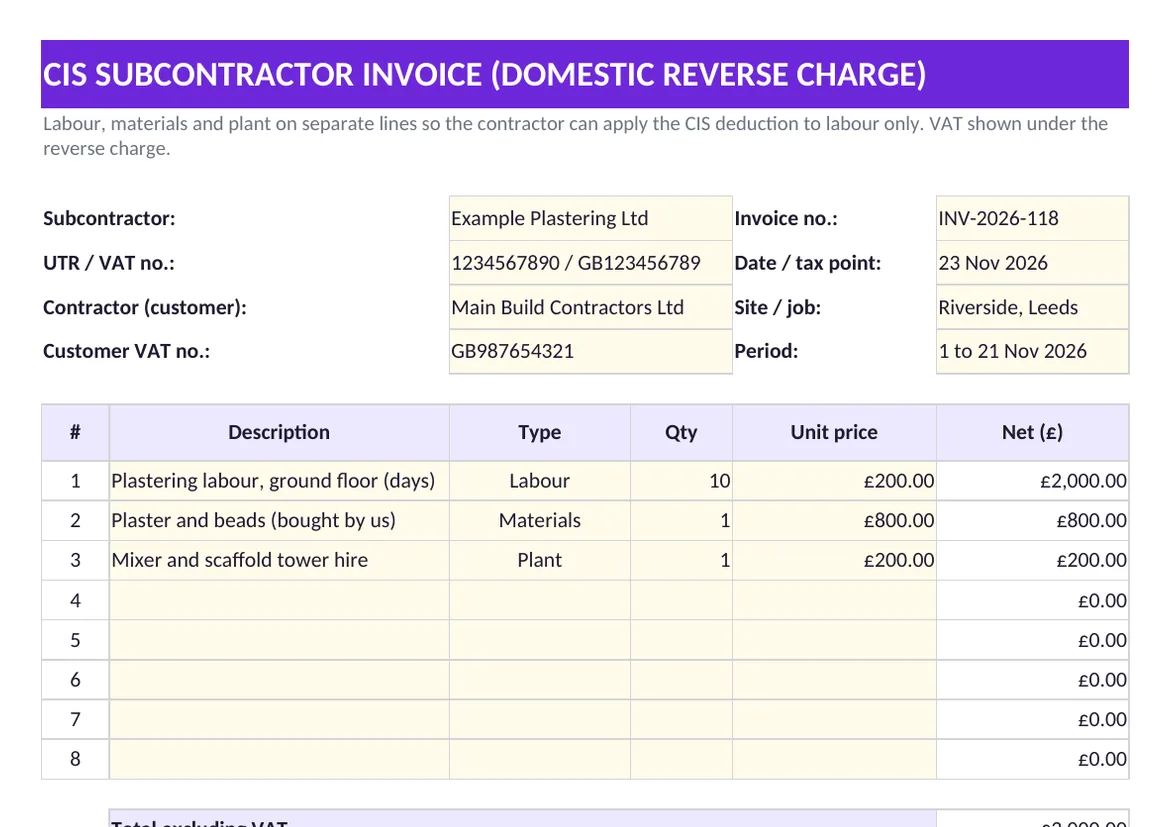
| Labour | £2,000 | Deduction 20% = £400 |
| Materials bought by the subcontractor | £800 | No deduction |
| Plant hire | £200 | No deduction |
| Total excluding VAT | £3,000 | |
| VAT 20% under the reverse charge | £600 | Customer accounts for it to HMRC |
| Paid to the subcontractor | £2,600 | £3,000 − £400 |
VAT domestic reverse charge on construction invoices
Since 1 March 2021 most building and construction services between VAT-registered businesses that are reported under CIS use the VAT domestic reverse charge. The subcontractor does not charge VAT; the contractor accounts for it to HMRC instead. The charge applies to standard and reduced rate services.
- Invoice wording: the invoice must include the reference "reverse charge" and show the VAT amount (or the rate) without adding it to the total. HMRC's example wording is "Customer to pay the VAT to HMRC" or "VAT Act 1994 Section 55A applies".
- End users: if the customer tells you in writing that it is an end user or an intermediary supplier, charge VAT normally.
- Private customers: the reverse charge does not apply to a householder, because they are not VAT registered.
- 5% disregard: where the reverse-charge element of a single supply is 5% or less of its value, and both sides agree at the start, normal VAT can be used.
- Outside scope: architects' and surveyors' professional work, delivering materials, signwriting, installing security systems, seating, blinds and shutters are not reverse-charge services on their own.
Worked examples with different statuses
| Same £3,000 invoice | CIS deduction | VAT on the invoice | Payment to subcontractor |
|---|---|---|---|
| Registered, reverse charge | £400 | £600 accounted by the customer | £2,600.00 |
| Registered, end user notified (normal VAT) | £400 | £600 charged | £3,200.00 |
| Not registered for CIS, not VAT registered | £600 (30%) | None | £2,400.00 |
| Gross payment status, reverse charge | £0 | £600 accounted by the customer | £3,000.00 |
Contractor obligations and deadlines
- Verify a new subcontractor with HMRC before you pay them, and again if they have not been on a CIS return in the current or last 2 tax years.
- Payment and deduction statement to the subcontractor within 14 days of the end of each tax month.
- Monthly return by the 19th of the month after the tax month; late filing starts at a £100 penalty.
- Pay HMRC the deductions by the 22nd (19th if paying by post).
- Records for at least 3 years after the end of the tax year; a fine of up to £3,000 applies if you cannot show them.
- Deemed contractors: a business that does not do construction but spends more than £3 million on it in 12 months must operate CIS too.
How to use the calculator and the invoice template
- Split the invoice into labour, materials the subcontractor paid for, and plant hire or consumables.
- Pick the rate HMRC gave on verification and the VAT treatment: reverse charge, normal VAT or not VAT registered.
- Read the CIS deduction, the VAT and the amount to pay.
- Download the CIS invoice template: each line has a type (Labour, Materials, Plant), the labour total feeds the deduction, and the footer carries the reverse charge wording. Change the rate cell to 30% or 0% if needed.
Common mistakes
- Deducting CIS from the whole invoice, including materials and VAT.
- Charging VAT on a reverse-charge supply, so the contractor pays VAT to you instead of HMRC.
- Using the reverse charge for a private homeowner or for a customer who notified end user status.
- Paying a new subcontractor before verifying them, and guessing the rate.
- Treating travel fuel as deductible: only fuel used on the job counts.
Construction jobs in Draivix
Draivix keeps the job, the subcontractor invoices and the costs in one place in construction jobs and budgets, and issues your own invoices from invoicing and billing with print templates you control. Draivix does not file CIS returns or verify subcontractors with HMRC; your accountant or payroll software does that. More for builders on the construction companies page.
02Frequently Asked Questions
How do I calculate a CIS deduction?
Take the invoice total, remove VAT, materials the subcontractor bought, plant hire, consumables and job fuel, and apply the HMRC rate to what is left, which is labour. On £2,000 of labour at 20% the deduction is £400.
What are the CIS rates?
20% for subcontractors registered for CIS, 30% for those not registered, and 0% for subcontractors with gross payment status. HMRC tells the contractor which applies when it verifies the subcontractor.
What must a reverse charge invoice say?
It must include the reference "reverse charge" and show the VAT due under it. HMRC's example wording includes "Customer to pay the VAT to HMRC" and "VAT Act 1994 Section 55A applies".
Does the reverse charge apply to work for homeowners?
No. Private domestic customers are not VAT registered, so the subcontractor charges VAT normally.
When must a contractor pay CIS deductions to HMRC?
By the 22nd of the month after the tax month, or the 19th if paying by post. The monthly return is due by the 19th.
Is CIS deducted from materials?
No, as long as the subcontractor paid for them directly. The contractor can ask for receipts and must estimate the cost if there is no evidence.
03More Free UK Tools
Related UK Calculators, Templates & Guides
- Pro forma invoice template UK (Excel and PDF, free)Free UK pro forma invoice template in Excel and PDF, marked "this is not a VAT invoice" as VAT Notice 700 asks, plus when to issue the VAT invoice.Open
- Minimum wage 2027 UK: £13.21 from April, all ratesUK minimum wage: £12.71 for 21+ from April 2026, rising to £13.21 on 1 April 2027 (18-20: £11.27, under 18 and apprentices: £8.31). Checker and Excel sheet.Open
- Statutory sick pay 2026/27: £123.25 a week calculatorSSP is £123.25 a week or 80% of earnings, whichever is lower, paid from the first day of sickness since 6 April 2026 for up to 28 weeks. Daily rates.Open
- VAT calculator UK: add or remove 20% VATFree UK VAT calculator: add or remove VAT at 20%, 5% or 0%, see what a Flat Rate Scheme business pays HMRC, with HMRC's rounding rules and an Excel version.Open
Let’s start together
Tell us how your business works.
We will show you what a system that takes over part of that work could look like.
Book a consultation