
01Free UK Template · Excel and PDF
UK e-invoicing from April 2029: what VAT-registered businesses must do, and when
UK e-invoicing from 1 April 2029: VAT invoices between VAT-registered businesses go over Peppol. Timeline, scope, exemptions and a readiness checklist.
What changes on 1 April 2029
From 1 April 2029 VAT-registered businesses and public bodies will have to issue their VAT invoices as e-invoices and be able to receive them, unless an exemption applies, and the UK will use Peppol as the network that connects their systems. HMRC and HM Treasury set this out in the e-invoicing implementation roadmap published on 28 October 2026, alongside Budget 2026; the 2029 start was first announced at Budget 2025. An e-invoice is structured invoice data exchanged directly between the supplier's and the buyer's systems; the roadmap says PDFs, word-processed files, images and HTML invoices do not count.
The rules on when a VAT invoice is needed do not change: a VAT-registered person must issue one for a taxable supply to another VAT-registered person in the UK. What changes is the form. Invoices to consumers, invoices for supplies outside VAT and invoices from businesses that are not VAT-registered are not VAT invoices, so they do not have to be e-invoices, although they can be.
The timeline, as at 23 November 2026
| When | What the roadmap promises |
|---|---|
| 28 October 2026 | Roadmap and e-invoicing requirements policy paper published; consultation on digital reporting of e-invoice data |
| Spring 2027 | Public technical consultation on UK e-invoicing standards and on Access Point certification |
| Spring 2027 | Primary legislation expected to become law, subject to Parliament |
| October 2027 to April 2028 | Requirements confirmed, at least 12 months before the start |
| End of 2027 | Guidance for specific groups of VAT-registered persons |
| By April 2028 | Exemption process for digitally excluded persons; updated VAT guidance |
| Spring to Winter 2028 | Software requirements, readiness testing, infrastructure |
| 1 April 2029 | E-invoicing required for VAT invoices; Access Points accredited |
Status of the law: the roadmap says the government intends to introduce the primary legislation as part of Finance Bill 2026 and expects it to become law in Spring 2027, subject to Parliamentary approval. The current Finance Bill was listed for its Commons second reading on 23 November 2026, with Committee of the whole House scheduled for 30 November and 1 December 2026. Until Royal Assent and the regulations, the requirement is government policy, not law. VAT invoice rules sit in the Value Added Tax Act 1994 and the VAT Regulations 1995.
Peppol and Access Points
- Peppol is an international framework of common standards, operating rules and network arrangements, governed by OpenPeppol, that lets businesses on different software exchange e-invoices.
- Access Points: businesses will normally connect through an Access Point provided by their software provider; Access Points will have to be accredited before 1 April 2029.
- UK Peppol Authority: today the function sits within NHS Supply Chain, because the NHS already uses Peppol; HMRC will take it over. The roadmap says the Peppol Authority will not receive copies of VAT invoices.
- EDI: businesses already exchanging invoices by EDI can carry on, but must also be able to exchange e-invoices through the framework.
- Penalties: HMRC plans to build on the existing VAT invoicing penalties framework, aiming to be proportionate.
Exemptions and who is affected
The government expects the requirement to apply broadly, with tightly defined exemptions: for digitally excluded VAT-registered persons, building on the Making Tax Digital for VAT criteria, and for technical cases where existing VAT rules are incompatible with e-invoicing. The process for applying will be published by April 2028. Sole traders, partnerships and charities are in scope if they are VAT-registered. VAT is a UK-wide tax, so the requirement covers England, Scotland, Wales and Northern Ireland alike.
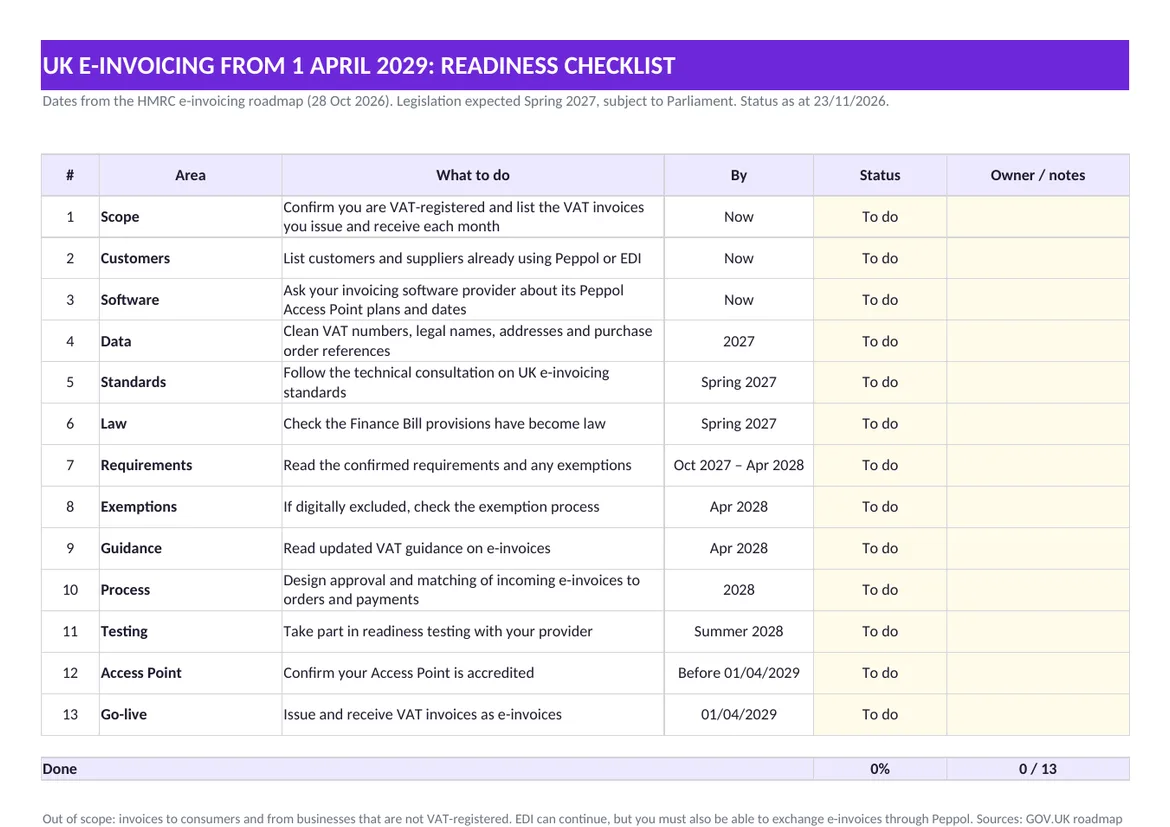
Readiness checklist
- Count how many VAT invoices you issue and receive a month, and which customers and suppliers already use Peppol or EDI.
- Ask your accounting or invoicing software provider whether it will be an accredited Access Point or partner with one, and by when.
- Clean the master data an e-invoice needs: VAT numbers, legal names, addresses and purchase order references.
- Decide how incoming e-invoices will be approved and matched to purchase orders and payments.
- Follow the Spring 2027 standards consultation and the confirmed requirements from October 2027.
- Keep issuing correct VAT invoices under VAT Notice 700 in the meantime; see the invoice template.
The download turns these into a dated checklist with an owner column and a progress counter.
Peppol e-invoices in Draivix today
Draivix's Peppol e-invoicing module checks that an issued invoice has the mandatory Peppol BIS fields, generates a UBL XML file and validates it against the XSD schema and Schematron rules. Each prepared e-invoice gets a delivery record with the recipient, access point, a SHA-256 hash of the file and its status. Draivix is not an Access Point: sending is done by an operator or an external Access Point provider, whose confirmation is then recorded. UK Access Point accreditation has not started yet, and Draivix makes no claim to it.
02Frequently Asked Questions
When does e-invoicing start in the UK?
On 1 April 2029 for VAT invoices between VAT-registered persons, according to the HMRC roadmap of 28 October 2026. The legislation is expected in Spring 2027.
Is UK e-invoicing law yet?
Not as at 23 November 2026. The government intends to legislate in Finance Bill 2026, expected to become law in Spring 2027, with detailed regulations to follow.
Is a PDF invoice an e-invoice?
No. An e-invoice is structured data exchanged directly between the supplier's and the buyer's systems; PDFs and paper are what e-invoicing replaces for VAT invoices.
Will the UK use Peppol?
Yes. The government announced at Tax Update Day 2026 that Peppol will be the UK's core interoperability framework, with HMRC becoming the UK Peppol Authority.
Do businesses that are not VAT-registered need e-invoicing?
No. Their invoices are not VAT invoices, so they are out of scope, although they can still receive or send e-invoices voluntarily.
Do invoices to consumers have to be e-invoices?
No. VAT invoices are not required for sales to consumers, so those invoices are out of scope.
Can we keep using EDI?
Yes, but the roadmap says businesses must also be able to exchange e-invoices through the Peppol framework.
03More Free UK Tools
Related UK Calculators, Templates & Guides
- Payslip template UK: free itemised pay statementFree UK payslip template in Excel and PDF with live totals: gross pay, hours, deductions and net pay as ERA 1996 s.8 requires, plus the Northern Ireland rules.Open
- Credit note template UK: free VAT credit noteFree UK VAT credit note template in Excel and PDF with every detail VAT Notice 700 (18.2.3) lists, live totals, and when the VAT adjustment goes on your return.Open
- Payroll calendar 2027/28: tax weeks and week 53UK payroll calendar 2027/28: tax weeks and months from 6 April 2027, week 53 on 4 and 5 April 2028, PAYE due dates and bank holiday pay dates by nation.Open
- Notice period calculator UK: statutory and contractWork out UK notice: 1 week per full year of service up to 12 weeks (ERA 1996 s.86), compared with your contract, and the last day of employment.Open
Let’s start together
Tell us how your business works.
We will show you what a system that takes over part of that work could look like.
Book a consultation