
01Free UK Template · Excel and PDF
Credit note template UK: free VAT credit note in Excel and PDF with HMRC's conditions
Free UK VAT credit note template in Excel and PDF with every detail VAT Notice 700 (18.2.3) lists, live totals, and when the VAT adjustment goes on your return.
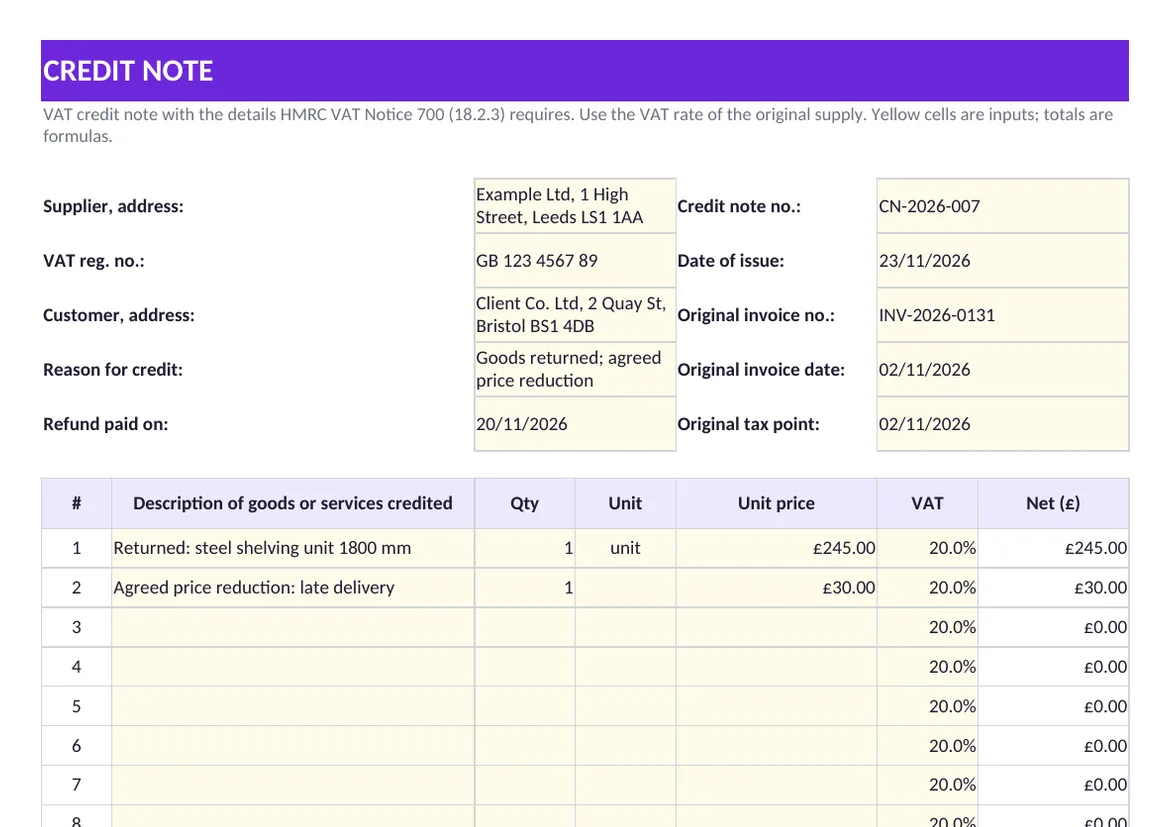
When a VAT credit note is valid
HMRC treats a credit note as valid for VAT only if it reflects a genuine mistake, overcharge or agreed reduction in the value of the supply, gives the customer a real entitlement to a refund or an offset, and is issued within 14 days of the refund being paid to the customer (VAT Notice 700, paragraph 18.2.3). HMRC will not make a repayment where a credit note does not meet those conditions. In law, regulation 15C(5) of the VAT Regulations 1995 requires the supplier to provide the credit note no later than 14 days beginning with the day the decrease in price occurs.
| Detail the credit note must show (18.2.3) | In the template |
|---|---|
| Identifying number and date of issue | Credit note no. and date |
| Supplier's name, address and VAT registration number | Supplier block |
| Customer's name and address | Customer block |
| Description of the goods or services credited | Line description |
| Quantity and amount for each description | Qty, unit price and net per line |
| Total amount credited, excluding VAT | Total credited excluding VAT |
| Rate and amount of VAT credited, in sterling | VAT rate per line and VAT credited |
| Number and date of the original VAT invoice | Original invoice no. and date |
Credits for zero-rated or exempt supplies must be totalled separately and the note must show that no VAT credit is allowed for them; the template shows that subtotal on its own line. If returned goods cannot be traced to a particular invoice, Notice 700 says you must be able to satisfy HMRC by other means that VAT was accounted for on the original supply.
Which VAT rate and which return
- Rate: use the VAT rate in force at the tax point of the original supply, not today's rate (18.2.5).
- Your records: when you issue a credit note, adjust your record of taxable supplies and your output tax, and make the nature of and reason for the adjustment clear in the accounts or supporting documents (18.2.6).
- Which VAT period: for a decrease in price, the adjustment goes in the VAT period in which the refund is paid to the customer (18.2.6). Regulation 38 of the VAT Regulations 1995 sets the same rule in law: where the price falls after the end of the period of the original supply, the supplier makes a negative entry in the VAT payable part of its VAT account, and a VAT-registered customer makes a negative entry in its VAT allowable part, both in the period in which the decrease occurs.
- Reverse charge: where the customer accounts for the VAT, for example under the construction reverse charge, the entry is made in the customer's VAT account, not the supplier's (regulation 38(1C) and (3A)).
- Errors already on a return: if the VAT itself was wrong and already declared, correct it under the error correction rules in VAT Notice 700/45, not with a credit note adjustment.
Agreeing not to adjust the VAT
If the customer can reclaim all the VAT on your supply, you and the customer may agree not to adjust the original VAT charge (18.2.1). The document you give must then say ‘This is not a credit note for VAT’, and you still adjust your records of outputs and inputs for the VAT return (18.2.3). Otherwise both of you adjust.
For prompt payment discounts you can issue a credit note when the discount is taken, or skip the credit note if the original invoice states the discount terms and that the customer can only recover the VAT actually paid. HMRC's suggested wording is: ‘A discount of X% of the full price applies if payment is made within Y days of the invoice date. No credit note will be issued. Following payment you must ensure you have only recovered the VAT actually paid.’ (18.2.2)
Worked example from the template
| Line | Qty | Unit price | VAT | Net |
|---|---|---|---|---|
| Returned: steel shelving unit 1800 mm | 1 | £245.00 | 20% | £245.00 |
| Agreed price reduction: late delivery | 1 | £30.00 | 20% | £30.00 |
| Total credited excluding VAT | £275.00 | |||
| VAT credited | £55.00 | |||
| Total credit | £330.00 |
Credit note CN-2026-007 is dated 23/11/2026 and refers to invoice INV-2026-0131 of 02/11/2026. The customer was refunded on 20/11/2026, so the note is issued within 14 days of the refund, and the £55.00 reduction in output tax belongs to the VAT period that includes 20 November 2026. The VAT total uses the same rounding as the VAT invoice template, so crediting a whole invoice reverses exactly the VAT charged.
Credit notes instead of deleting invoices
- Never delete or renumber an issued VAT invoice; cancel it with a credit note so the numbering stays continuous.
- Returned goods replaced with similar goods: either let the original VAT stand, or cancel it with a credit note and charge VAT on the replacement. If the replacement is cheaper you may reduce the VAT with a credit note; if dearer you must account for the extra VAT (18.3).
- For an undercharge, the supplier issues a debit note within 14 days of agreeing the increase (Notice 700, 18.2.4; VAT Regulations 1995, regulation 15C(2)).
- A pro forma invoice is not a VAT invoice, so cancelling one needs no credit note.
Credit notes in Draivix
In Draivix, invoicing and billing creates a credit note directly from an invoice and checks that both documents have the same customer and the same reverse-charge regime. Numbers come from a numbering sequence, a cancelled document never releases its number, and payment status is recalculated from recorded payments. Credit notes print from the ready-made templates in documents and print templates.
Sources and legal basis
- HMRC: VAT guide (VAT Notice 700), section 18 (credits and debts)
- Value Added Tax Regulations 1995, regulation 38 (adjustments in the course of business)
- Value Added Tax Regulations 1995, regulation 15C (debit notes and credit notes within 14 days)
- HMRC: How to correct VAT errors and make adjustments or claims (VAT Notice 700/45)
Facts checked:
02Frequently Asked Questions
What must a VAT credit note include?
Its number and date, the supplier's name, address and VAT number, the customer's name and address, a description, quantity and amount per line, the total credited excluding VAT, the rate and amount of VAT credited, and the number and date of the original invoice (Notice 700, 18.2.3).
How long do I have to issue a credit note?
For VAT purposes, within 14 days of the refund payment being made to the customer, and it must reflect a genuine mistake, overcharge or agreed reduction.
Which VAT rate goes on a credit note?
The rate that applied at the tax point of the original supply, even if the rate has changed since.
Which VAT return does a credit note go on?
For a reduction in price, the VAT period in which you pay the refund to the customer; regulation 38 of the VAT Regulations 1995 puts the adjustment in the period in which the decrease occurs.
Can I issue a credit note without VAT?
Yes, if you and the customer agree not to adjust the VAT and the customer can reclaim all the VAT. The note must say ‘This is not a credit note for VAT’, and you still adjust your records.
Is a credit note the same as a refund?
No. A credit note records the reduction; the customer gets a refund or offsets the credit against future invoices. HMRC's validity test needs that entitlement to be real.
03More Free UK Tools
Related UK Calculators, Templates & Guides
- Payroll calendar 2027/28: tax weeks and week 53UK payroll calendar 2027/28: tax weeks and months from 6 April 2027, week 53 on 4 and 5 April 2028, PAYE due dates and bank holiday pay dates by nation.Open
- Notice period calculator UK: statutory and contractWork out UK notice: 1 week per full year of service up to 12 weeks (ERA 1996 s.86), compared with your contract, and the last day of employment.Open
- Delivery note template UK: free Excel and PDFFree UK delivery note template in Excel and PDF: items ordered, sent and outstanding, a proof of delivery signature, and how delivery sets the VAT tax point.Open
- Statement of account template UK: free Excel, PDFFree UK statement of account template in Excel and PDF: open invoices, aged balance and a remittance advice slip, with late payment and limitation rules.Open
Let’s start together
Tell us how your business works.
We will show you what a system that takes over part of that work could look like.
Book a consultation