
01Free UK Template · Excel and PDF
Statement of account template UK: free customer statement with aged debt and a remittance advice
Free UK statement of account template in Excel and PDF: open invoices, aged balance and a remittance advice slip, with late payment and limitation rules.
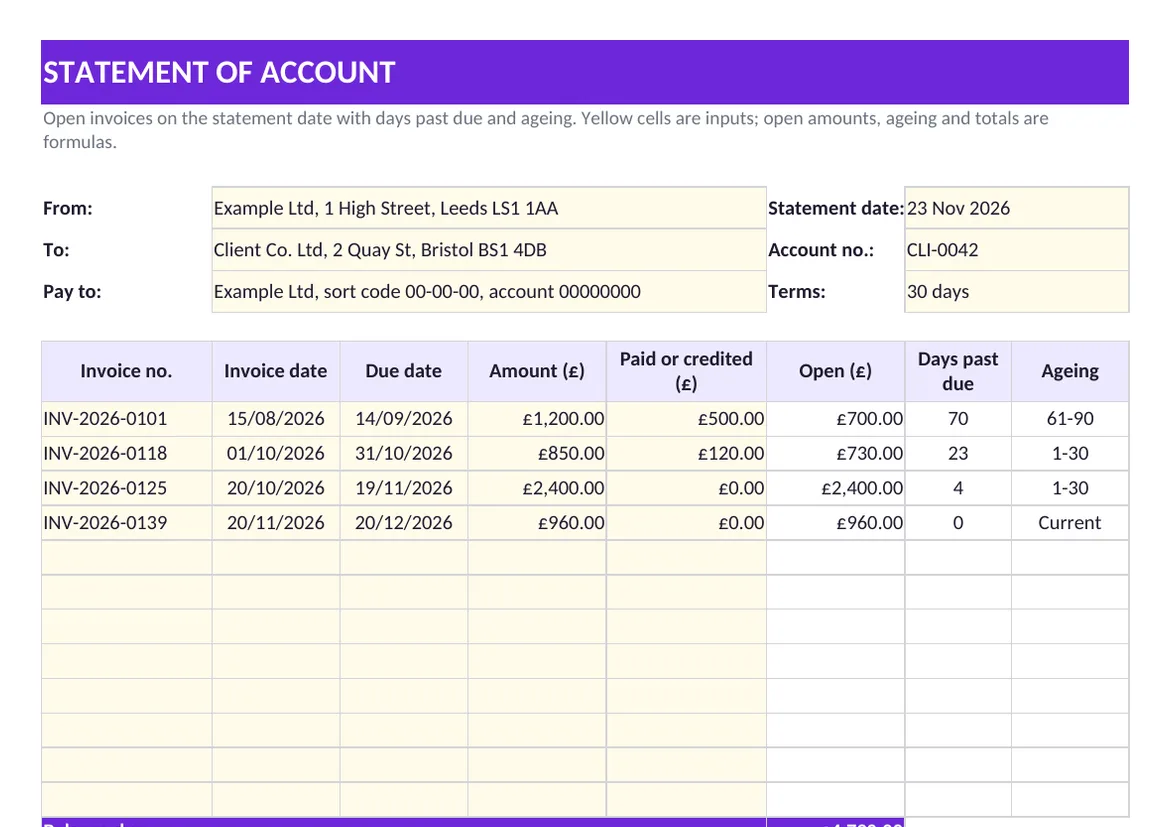
What a statement of account shows
A statement of account lists every invoice a customer has not fully paid, what has been paid or credited against each, and the balance due on the statement date, grouped by how overdue it is. It is not a VAT document and no law prescribes its layout; it is how a supplier asks for payment of several invoices at once and how both sides reconcile their ledgers. The template calculates the open amount, the days past due and the ageing bucket of each invoice from the statement date.
| Column | Formula in the template |
|---|---|
| Open amount | Invoice amount − paid or credited |
| Days past due | Statement date − due date, 0 if not yet due |
| Ageing bucket | Current, 1–30, 31–60, 61–90 or over 90 days |
| Balance due | Sum of open amounts |
Worked example from the template
| Invoice | Date | Due | Amount | Paid or credited | Open | Days past due |
|---|---|---|---|---|---|---|
| INV-2026-0101 | 15/08/2026 | 14/09/2026 | £1,200.00 | £500.00 | £700.00 | 70 |
| INV-2026-0118 | 01/10/2026 | 31/10/2026 | £850.00 | £120.00 (credit note CN-2026-0007) | £730.00 | 23 |
| INV-2026-0125 | 20/10/2026 | 19/11/2026 | £2,400.00 | £0.00 | £2,400.00 | 4 |
| INV-2026-0139 | 20/11/2026 | 20/12/2026 | £960.00 | £0.00 | £960.00 | 0 (current) |
On the statement date 23/11/2026 the balance due is £4,790.00: £960.00 current, £3,130.00 at 1–30 days, nothing at 31–60 days, £700.00 at 61–90 days and nothing over 90 days. The credit note template produces the credit against INV-2026-0118.
Late payment interest and recovery costs
Between businesses, GOV.UK says payment is late 30 days after the customer gets the invoice or the goods or service if no date was agreed, and agreed terms must usually be within 60 days. Under the Late Payment of Commercial Debts (Interest) Act 1998 you can claim statutory interest at 8% plus the Bank of England base rate and a fixed sum of £40 for a debt up to £999.99, £70 from £1,000 to £9,999.99 and £100 from £10,000, once for each payment. GOV.UK suggests sending a new invoice when you add interest. The late payment interest calculator works out the figures for each invoice.
Limitation periods and acknowledgments
- England and Wales: a claim for a debt under a simple contract must be brought within 6 years from when the cause of action accrued (Limitation Act 1980, section 5). If the debtor acknowledges the debt or pays part of it, time starts again from that date (section 29(5)), but only if the acknowledgment is in writing and signed by the debtor (section 30). A debt that is already time-barred is not revived (section 29(7)).
- Scotland: an obligation to pay a debt is extinguished after 5 years under section 6 of the Prescription and Limitation (Scotland) Act 1973, unless a relevant claim is made or the obligation is relevantly acknowledged, for example by part payment or by an unequivocal written admission by the debtor (section 10).
- Northern Ireland: the Limitation (Northern Ireland) Order 1989, article 4, sets 6 years for actions founded on simple contract.
- What this means for statements: a statement you send is not an acknowledgment by the customer. A balance confirmation the customer signs and returns, or a part payment, can be.
The remittance advice sheet
The second sheet is a remittance advice: the customer ticks the invoices they are paying, and the sheet totals the payment and shows the payment reference to quote, so your bank receipt can be matched to invoices. It takes its invoice list from the statement, so the two always agree.
Statements and reminders in Draivix
Draivix does not produce a customer statement document. Invoicing and billing tracks each invoice as partially paid, paid or overpaid from recorded payments, payment reconciliation matches bank transactions to invoices, and recurring billing and dunning sends staged reminders before, on and after the due date, and holds a reminder when an unmatched payment for the exact balance is already in the bank.
Sources and legal basis
- GOV.UK: Late commercial payments, charging interest and debt recovery
- Limitation Act 1980, section 5 (simple contract)
- Limitation Act 1980, sections 29 and 30 (acknowledgment and part payment)
- Prescription and Limitation (Scotland) Act 1973, section 6
- Limitation (Northern Ireland) Order 1989, article 4
Facts checked:
02Frequently Asked Questions
What is a statement of account?
A summary sent to a customer of the invoices not yet fully paid, payments and credits against them, and the balance due on a date, usually grouped by how overdue each amount is.
Is a statement of account the same as an invoice?
No. Each sale still needs its own invoice. The statement summarises invoices and is not a VAT invoice.
How often should I send statements?
No rule says. Many businesses send them monthly, after the month's invoices and payments are recorded.
Can I add interest to an overdue balance?
For business customers, yes: statutory interest at 8% over the Bank of England base rate and a fixed recovery sum, unless your contract sets a different substantial remedy.
How long can I chase an unpaid invoice?
6 years from when the debt became due in England, Wales and Northern Ireland, and 5 years in Scotland. A signed written acknowledgment or part payment by the debtor restarts the period in England and Wales.
What is a remittance advice?
A note from the customer saying which invoices a payment covers. The template's second sheet builds one from the statement.
03More Free UK Tools
Related UK Calculators, Templates & Guides
- Hourly rate calculator UK: salary to hourly wageConvert a UK salary to an hourly rate, or an hourly wage to annual, monthly and weekly pay, and check it against the minimum wage for April 2026 or 2027.Open
- Working days calculator UK with bank holidaysCount UK working days between two dates or add working days to a date, without weekends and bank holidays for England and Wales, Scotland or Northern Ireland.Open
- Staff rota template UK: free weekly rota (Excel)Free weekly staff rota template in Excel and PDF: shifts, hours per person and checks for the 20-minute break, 11 hours' rest and the 48-hour week.Open
- Job sheet template UK: free job card (Excel, PDF)Free UK job sheet template in Excel and PDF: work requested, labour hours, parts used, totals to invoice and customer sign-off, with the rules behind them.Open
Let’s start together
Tell us how your business works.
We will show you what a system that takes over part of that work could look like.
Book a consultation