
01Free UK Template · Excel and PDF
Staff rota template UK: free weekly rota in Excel that checks breaks, rest and weekly hours
Free weekly staff rota template in Excel and PDF: shifts, hours per person and checks for the 20-minute break, 11 hours' rest and the 48-hour week.
The working time rules a rota has to respect
A rota for adult workers in Great Britain should give a 20-minute uninterrupted break in any shift of more than 6 hours, 11 hours' rest between working days, 24 hours off each week (or 48 hours each fortnight) and no more than 48 hours a week on average over 17 weeks. Those are GOV.UK's summaries of the Working Time Regulations 1998. The template flags a shift that breaks the first two rules and a week over 48 hours, so problems show up before the rota is published.
| Rule | Adult workers | Young workers (under 18, over school leaving age) |
|---|---|---|
| Break during the shift | 20 minutes when working more than 6 hours | 30 minutes when working more than 4.5 hours |
| Daily rest | 11 hours between working days | 12 hours |
| Weekly rest | 24 hours a week or 48 hours a fortnight | 48 hours a week |
| Working hours | 48 a week on average over 17 weeks; opt-out allowed | 8 hours a day and 40 a week; no opt-out |
The break must be taken in one go somewhere in the middle of the day, not at the start or end, and the worker must be allowed to spend it away from their workstation. It does not have to be paid unless the contract says so. Shift workers who change shifts and cannot take daily or weekly rest between them may be entitled to compensatory rest instead.
Northern Ireland
In Northern Ireland the same limits come from the Working Time Regulations (Northern Ireland) 2016: 11 hours' daily rest (regulation 12), 24 hours a week or 48 a fortnight (regulation 13) and a 20-minute break after 6 hours (regulation 14). NI Direct gives the young worker rules too: a 30-minute break after 4.5 hours, 12 hours' daily rest and 48 hours a week off. The template's checks work unchanged there.
How the template works
- Type each person's start time, finish time and unpaid break in minutes for Monday to Sunday; leave a day blank for a day off. A shift that ends after midnight is handled.
- Hours = finish − start − break, added up for the week per person and for the whole team.
- Break check: a shift with more than 6 hours of working time (finish − start − break) and a break under 20 minutes is flagged, because regulation 12 counts daily working time, not time on site.
- Rest check: the gap from the end of one day's shift to the start of the next day's shift under 11 hours is flagged.
- Week check: more than 48 hours in the week is flagged as a prompt to check the 17-week average and any opt-out; one long week is not a breach by itself.
| Example week in the download | Hours | Flag |
|---|---|---|
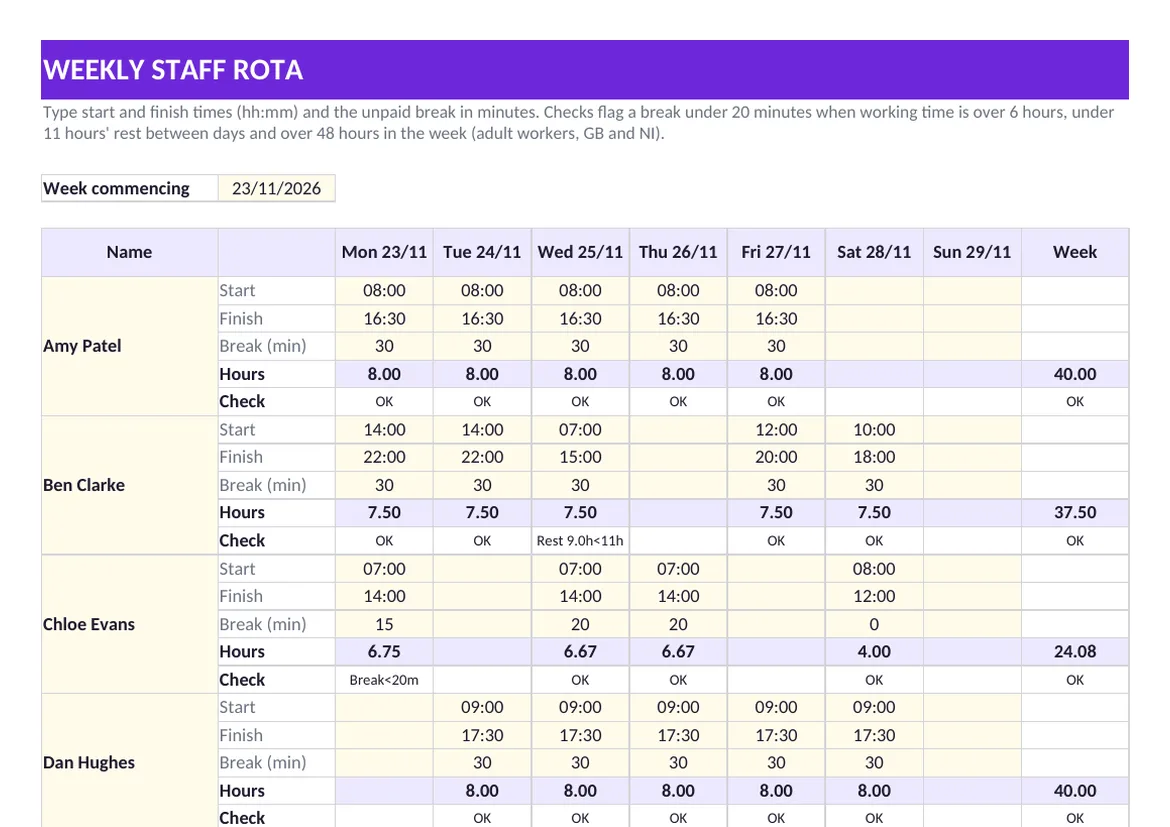
| Amy Patel, Monday to Friday 08:00–16:30 with 30 minutes' break | 40.00 | None |
| Ben Clarke, closes 22:00 on Tuesday and opens 07:00 on Wednesday | 37.50 | Rest under 11 hours (9 hours) |
| Chloe Evans, Monday 07:00–14:00 with 15 minutes' break | 24.08 | Break under 20 minutes |
| Dan Hughes, Tuesday to Saturday 09:00–17:30 with 30 minutes' break | 40.00 | None |
| Team total | 141.58 | 2 flags |
Records you have to keep
Regulation 9 of the Working Time Regulations 1998 requires records adequate to show that the weekly limit, the night work limits and the young worker limits are met, kept for 2 years. Since 1 January 2024 employers in Great Britain do not have to record each worker's daily hours if they can show compliance another way (regulation 9(3), added by SI 2023/1426). In Northern Ireland, regulation 11 of the 2016 Regulations sets the same 2-year record duty without that relaxation. A published rota shows planned hours; keep actual hours from timesheets, for example the weekly timesheet template.
The Employment Rights Act 2025 will give zero-hours and low-hours workers rights to reasonable notice of shifts and pay for shifts cancelled at short notice. As at 23 November 2026 those rights are not in force: sections 1 to 4 of the Act have been commenced only for consulting on and making the regulations (SI 2026/3); see the April 2027 employer changes.
Shifts and attendance in Draivix
Draivix does not build rotas. Its time and attendance records clock-ins from an RFID terminal, the browser or a phone, builds each day's schedule from the employee's work calendar, public holidays and approved absences, and treats a shift left open for more than 18 hours as unclosed. The monthly timesheet then goes to the manager and the payroll accountant for approval.
Sources and legal basis
- GOV.UK: Rest breaks at work
- GOV.UK: Maximum weekly working hours
- Working Time Regulations 1998, regulation 9 (records)
- Working Time Regulations (Northern Ireland) 2016, regulation 14 (rest breaks)
- NI Direct: Rest breaks
- Working Time Regulations (Northern Ireland) 2016, regulation 11 (records)
- SI 2026/3: Employment Rights Act 2025 (Commencement No. 1) Regulations 2026, regulation 2
Facts checked:
02Frequently Asked Questions
What breaks must be on a staff rota?
Adult workers need one uninterrupted 20-minute break in a working day of more than 6 hours, taken during the day rather than at the start or end. Workers under 18 need 30 minutes after 4.5 hours.
How many hours must there be between shifts?
11 hours between working days for adults and 12 hours for young workers, unless compensatory rest applies, for example for some shift workers.
Can staff work more than 48 hours a week?
Adults can in some weeks, because the limit is an average over 17 weeks, and they can opt out in writing. Workers under 18 cannot work more than 40 hours a week.
How much notice of a rota do staff get?
As at 23 November 2026 there is no general statutory notice period for shifts; the contract decides. The Employment Rights Act 2025 adds rights on shift notice, but they are not yet in force.
How long do I keep rota and working time records?
Records showing compliance with the weekly limit, night work and young worker limits must be kept for 2 years (WTR 1998, regulation 9).
Is the staff rota template free?
Yes. Download the Excel or PDF version and use it as often as you like.
03More Free UK Tools
Related UK Calculators, Templates & Guides
- Job sheet template UK: free job card (Excel, PDF)Free UK job sheet template in Excel and PDF: work requested, labour hours, parts used, totals to invoice and customer sign-off, with the rules behind them.Open
- Stamp duty calculator UK: SDLT, LBTT and LTTStamp duty calculator for England and NI (SDLT), Scotland (LBTT) and Wales (LTT): first-time buyer relief, second homes and companies, rates as at 23/11/2026.Open
- Capital Gains Tax calculator UK 2026/27Capital Gains Tax calculator for 2026/27: 18% and 24%, the £3,000 allowance, BADR at 18% and the 60-day rule for UK property, with HMRC's worked examples.Open
- Bank holidays Scotland 2027: all 9 datesScotland has 9 bank holidays in 2027, including 4 January, St Andrew's Day on 30 November and no Easter Monday, with 252 working days and a Scottish calculator.Open
Let’s start together
Tell us how your business works.
We will show you what a system that takes over part of that work could look like.
Book a consultation