
01Free UK Template · Excel and PDF
Timesheet template UK: free weekly timesheet in Excel and PDF that adds up the hours
Free weekly timesheet template for UK staff in Excel and PDF: start, finish, breaks, hours and pay worked out for you, plus the working time rules to check.
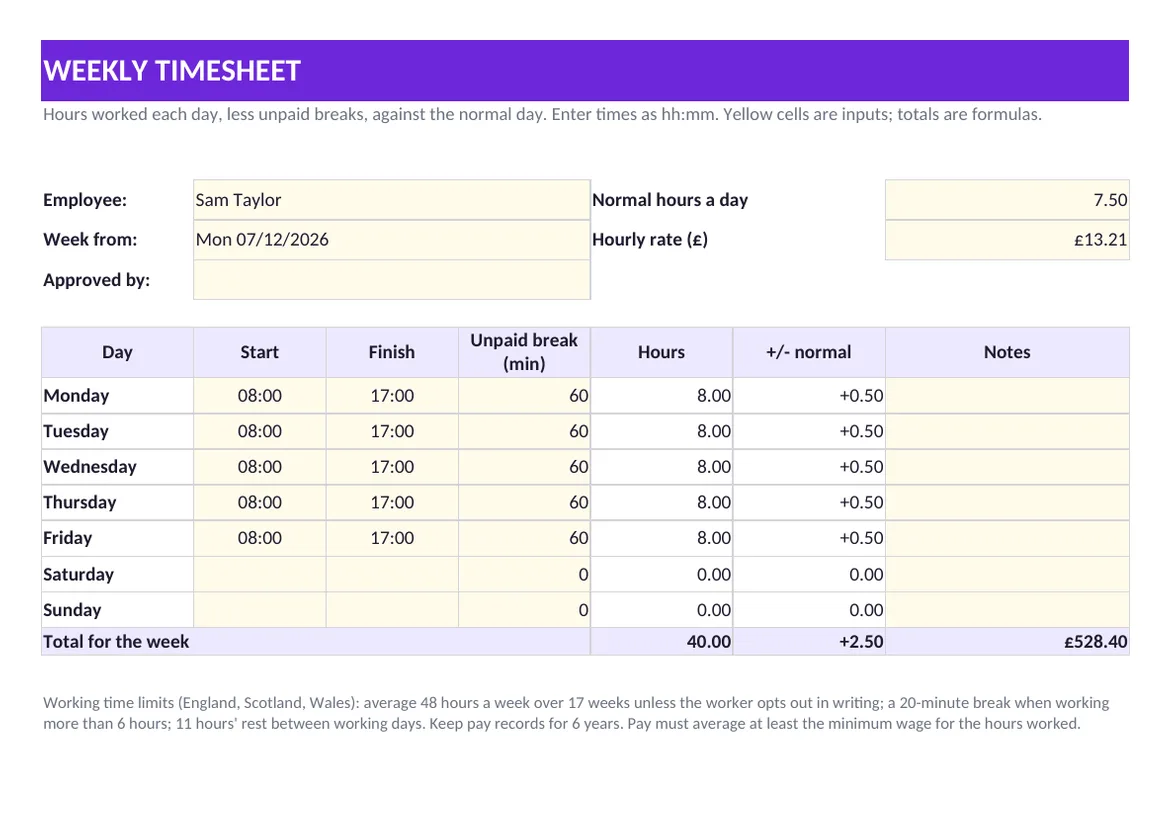
What the weekly timesheet does
Type each day's start and finish times and the unpaid break; the sheet works out the hours, the difference from a normal day, the weekly total and the pay. It covers one employee for Monday to Sunday and prints on one A4 page. Times go in as hh:mm, for example 08:00, and shifts that cross midnight are handled.
| Column | What to enter or what it shows |
|---|---|
| Start, Finish | Clock times, hh:mm |
| Unpaid break (min) | Minutes not paid, such as lunch |
| Hours | Finish − start − break, to 2 decimals |
| +/- normal | Hours over or under the normal day set at the top |
| Total for the week | Hours, difference and pay at the hourly rate |
Worked example
Sam works Monday to Friday from 08:00 to 17:00 with an unpaid hour for lunch. Each day is 8 hours, half an hour more than the 7.5-hour normal day.
| Item | Working | Result |
|---|---|---|
| Hours a day | 17:00 − 08:00 − 60 minutes | 8.00 |
| Hours for the week | 8 × 5 | 40.00 |
| Over the normal day | (8 − 7.5) × 5 | +2.50 |
| Pay for the week | 40 × £13.21 | £528.40 |
£13.21 is the National Living Wage for workers aged 21 and over from 1 April 2027; from 1 April 2026 it is £12.71. Check the minimum wage rates for younger workers and apprentices.
Working time rules to check on every timesheet
| Rule | Limit (GOV.UK) |
|---|---|
| Weekly hours | No more than 48 a week on average, normally over 17 weeks, unless the worker has opted out in writing |
| Under 18s | No more than 8 hours a day or 40 a week, with no averaging |
| Rest break | 20 minutes uninterrupted when working more than 6 hours a day (30 minutes after 4.5 hours for under 18s) |
| Daily rest | 11 hours between working days |
| Weekly rest | 24 hours uninterrupted each week, or 48 hours each fortnight |
Breaks do not have to be paid unless the contract says so, which is why the template deducts them. Northern Ireland has its own working time regulations, so check NI Direct there.
Records you must keep
- Minimum wage: records proving the National Minimum Wage or National Living Wage was paid, kept for at least 6 years (GOV.UK).
- Holiday: leave taken and holiday pay, kept for 6 years from 6 April 2026.
- Hourly-paid and irregular-hours staff: timesheets are the evidence for both, and for holiday pay averaged over 52 paid weeks.
- Keep the approved copy: the "Approved by" field shows who signed off the week.
Timesheets in Draivix
Once timesheets arrive by email from a dozen people, the spreadsheet stops scaling. Time and attendance in Draivix records clock-ins by RFID, web, GPS phone or BLE, builds the monthly timesheet and takes it through approval, and timesheets and time tracking adds a task timer and imports from Toggl, Clockify and Kimai, allocating the time to tasks and projects.
Sources and legal basis
- GOV.UK: Maximum weekly working hours
- GOV.UK: Rest breaks at work
- GOV.UK: National Minimum Wage and National Living Wage (keeping records)
- GOV.UK: National Minimum Wage and National Living Wage rates
- GOV.UK: Holiday entitlement (statutory leave, bank holidays, records)
Facts checked:
02Frequently Asked Questions
Is this timesheet template free?
Yes. Download the Excel version to fill in on screen or the PDF to print and fill in by hand.
How do I calculate hours worked on a timesheet?
Finish time minus start time minus unpaid breaks. 08:00 to 17:00 with an hour's lunch is 8 hours. The template does it for you.
Do employers have to keep timesheets in the UK?
There is no rule that it must be a timesheet, but employers must keep records proving minimum wage pay for 6 years and holiday records for 6 years. For hourly staff, timesheets are the usual evidence.
Are lunch breaks paid in the UK?
Only if the contract says so. Workers are entitled to a 20-minute rest break when working more than 6 hours, but it does not have to be paid.
What is the maximum working week in the UK?
48 hours on average, normally over 17 weeks. Workers over 18 can opt out in writing; under-18s cannot work more than 40 hours a week.
Can I use the timesheet for overtime?
Yes. The "+/- normal" column shows each day's hours over or under the normal day, and the weekly total shows the overtime.
03More Free UK Tools
Related UK Calculators, Templates & Guides
- Quote template UK: free quotation (Excel and PDF)Free UK quote template in Excel and PDF: lines, VAT, totals and a validity date, plus quote versus estimate and the consumer rules on price and cancellation.Open
- Purchase order template UK: free PO (Excel and PDF)Free UK purchase order template in Excel and PDF with PO number, delivery date, VAT and totals, plus payment terms and the late payment rules suppliers rely on.Open
- Profit margin calculator: margin, markup and VATWork out gross profit margin and markup from cost and price, or the price for a target margin, with 20% or 5% VAT added and a free product margin sheet.Open
- Risk assessment template UK: free form and exampleFree UK risk assessment template in Excel and PDF: HSE's five steps, a 5×5 risk matrix, a worked example and a method statement. Written record at 5+ staff.Open
Let’s start together
Tell us how your business works.
We will show you what a system that takes over part of that work could look like.
Book a consultation