
01Free UK Template · Excel and PDF
Risk assessment template UK: free form with a 5×5 matrix, worked example and method statement
Free UK risk assessment template in Excel and PDF: HSE's five steps, a 5×5 risk matrix, a worked example and a method statement. Written record at 5+ staff.
What the law asks for
Every employer must make a suitable and sufficient assessment of the risks to the health and safety of employees, and of anyone else affected by the work, and an employer with 5 or more employees must record the significant findings. That is regulation 3 of the Management of Health and Safety at Work Regulations 1999 (SI 1999/3242). The record must also name any group of employees identified as especially at risk, and the assessment must be reviewed when it may no longer be valid or the work has changed significantly. Before employing a young person, the employer must take their inexperience and immaturity into account.
HSE describes the process as five steps: identify hazards, assess the risks, control the risks, record your findings, review the controls. You can do it yourself or appoint a competent person to help. HSE publishes its own simple template and examples, and the template on this page follows the same steps with a scoring column added.
How to fill in the template
| Column | What to write |
|---|---|
| Hazard | Anything that may cause harm: a wet floor, a ladder, a chemical, lifting, display screen work, lone working |
| Who might be harmed and how | Groups, not names: staff, cleaners, visitors, contractors, young workers, expectant mothers |
| Controls already in place | What you do today: guards, training, PPE, signage, inspections |
| Likelihood and severity (1 to 5) | How likely harm is with today's controls, and how bad it would be |
| Risk score and rating | Calculated: likelihood × severity, then Low, Medium, High or Very high |
| Further action | What else is reasonably practicable to reduce the risk |
| Who, by when, done | An owner, a date and a tick, so the action is tracked |
| Residual score | The score you expect once the further action is in place |
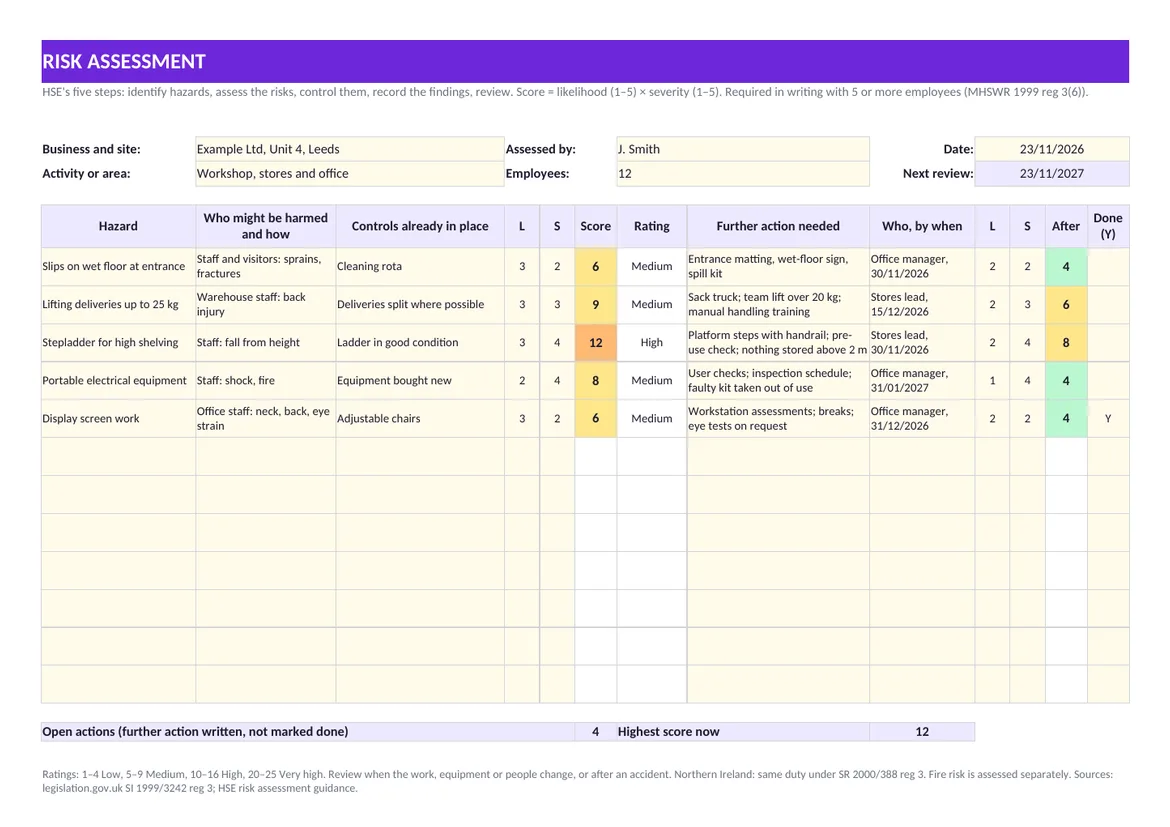
The workbook works the score and the rating out for you, counts open actions and prints on A4. Keep the finished assessment where staff can see it and tell them what it found.
The 5×5 risk matrix
HSE does not require a scoring method; a matrix is simply a consistent way to rank risks so the worst are dealt with first. The template uses likelihood 1 (rare) to 5 (almost certain) and severity 1 (negligible) to 5 (fatal or permanent disability).
| Likelihood ↓ / Severity → | 1 | 2 | 3 | 4 | 5 |
|---|---|---|---|---|---|
| 5 Almost certain | 5 | 10 | 15 | 20 | 25 |
| 4 Likely | 4 | 8 | 12 | 16 | 20 |
| 3 Possible | 3 | 6 | 9 | 12 | 15 |
| 2 Unlikely | 2 | 4 | 6 | 8 | 10 |
| 1 Rare | 1 | 2 | 3 | 4 | 5 |
Ratings used: 1 to 4 Low (keep under review), 5 to 9 Medium (act within a set time), 10 to 16 High (act promptly, consider stopping the task), 20 to 25 Very high (stop until the risk is reduced).
Risk assessment example: a small workshop and office
| Hazard | Who and how | Score now | Further action | Residual |
|---|---|---|---|---|
| Slips on a wet floor at the entrance | Staff and visitors: sprains, fractures | 3 × 2 = 6 Medium | Entrance matting, wet-floor sign, spill kit | 2 × 2 = 4 Low |
| Lifting deliveries up to 25 kg | Warehouse staff: back injury | 3 × 3 = 9 Medium | Sack truck, team lift over 20 kg, manual handling training | 2 × 3 = 6 Medium |
| Stepladder used for high shelving | Staff: fall from height | 3 × 4 = 12 High | Platform steps with handrail, pre-use check, nothing stored above 2 m | 2 × 4 = 8 Medium |
| Portable electrical equipment | Staff: shock, fire | 2 × 4 = 8 Medium | User checks, visual inspection schedule, faulty kit taken out of use | 1 × 4 = 4 Low |
| Display screen work | Office staff: neck, back and eye strain | 3 × 2 = 6 Medium | Workstation assessment, breaks, eye tests on request | 2 × 2 = 4 Low |
These rows are filled in as a sample in the download so you can see the format; replace them with the hazards of your own workplace. A fire risk assessment is a separate legal duty with its own rules: use the fire risk assessment template.
Method statements and RAMS
A method statement sets out, step by step, how a particular job will be done safely: the sequence, the equipment, the people and their competence, the permits and the emergency arrangements. Paired with the risk assessment it is often called RAMS, and main contractors commonly ask subcontractors for one before work starts on site. RAMS is a working document rather than a form fixed in law; what the law requires is the suitable and sufficient assessment and, for 5 or more employees, the written record. The second tab of the download is a method statement you can fill in for a job.
Scotland, Wales and Northern Ireland
The 1999 Regulations apply across Great Britain, so the same duty covers England, Scotland and Wales, enforced by HSE or the local authority. Northern Ireland has its own Management of Health and Safety at Work Regulations (Northern Ireland) 2000 (SR 2000/388), whose regulation 3 sets the same duty, including the written record for 5 or more employees, enforced by HSENI and district councils.
Keeping actions and training on track in Draivix
Draivix does not write risk assessments. It keeps what follows from them: employee records track training and medical check-ups with due dates that appear in the calendar, and the documents library stores the signed assessment with a publication and expiry date, so you can see which documents are still valid. On construction sites the digital site logbook records daily entries and inspections with photos and signatures.
Sources and legal basis
- legislation.gov.uk: Management of Health and Safety at Work Regulations 1999 (SI 1999/3242), regulation 3
- legislation.gov.uk: Management of Health and Safety at Work Regulations (Northern Ireland) 2000 (SR 2000/388), regulation 3
- HSE: Risk assessment, steps needed to manage risk
- HSE: Risk assessment template and examples
Facts checked:
02Frequently Asked Questions
Is a risk assessment a legal requirement in the UK?
Yes. Regulation 3 of the Management of Health and Safety at Work Regulations 1999 requires every employer to make a suitable and sufficient assessment of the risks to employees and others affected by the work.
Do I have to write my risk assessment down?
If you employ 5 or more people you must record the significant findings and any group of employees especially at risk (regulation 3(6)). With fewer, writing it down is still the easiest way to show what you did.
What are HSE's five steps to risk assessment?
Identify hazards, assess the risks, control the risks, record your findings and review the controls.
How often should a risk assessment be reviewed?
The law sets no fixed interval: review it when there is reason to think it is no longer valid or when the work changes significantly, for example new equipment, a new process or an accident.
What is a RAMS?
A risk assessment and method statement: the risk assessment plus a step-by-step safe way of doing a specific job. Main contractors often ask for one before work on site.
Does HSE provide a risk assessment template?
Yes, HSE publishes a simple template and worked examples. The template here follows HSE's steps and adds a 5×5 score, action tracking and a method statement tab.
Who can carry out a risk assessment?
You can do it yourself or appoint a competent person to help, HSE says. Involve the people who do the work; they often know the hazards best.
03More Free UK Tools
Related UK Calculators, Templates & Guides
- Break-even point calculator and formulaBreak-even point = fixed costs ÷ (price − variable cost). Work out units, sales, margin of safety and the sales needed for a profit after UK corporation tax.Open
- Company car tax calculator 2026/27: BIK ratesCompany car tax 2026/27: BIK percentage from CO2 and electric range, P11D value, the driver's tax and employer Class 1A NI, with Budget 2026 rates to 2028/29.Open
- Salary sacrifice pension calculator 2026/27See what pension salary sacrifice saves in income tax, employee NI and employer NI in 2026/27, and how the £2,000 NI limit from April 2029 changes the saving.Open
- 2027 calendar UK: printable with bank holidaysFree printable 2027 calendar for the UK on A4: all 12 months with bank holidays for England and Wales, Scotland and Northern Ireland, and working days.Open
Let’s start together
Tell us how your business works.
We will show you what a system that takes over part of that work could look like.
Book a consultation