
01Free UK Template · Excel and PDF
Fire risk assessment template UK: free form, sample and the rules in each nation
Free fire risk assessment template and sample: hazards, people at risk, actions and review, with the record rules for England, Wales, Scotland and NI.
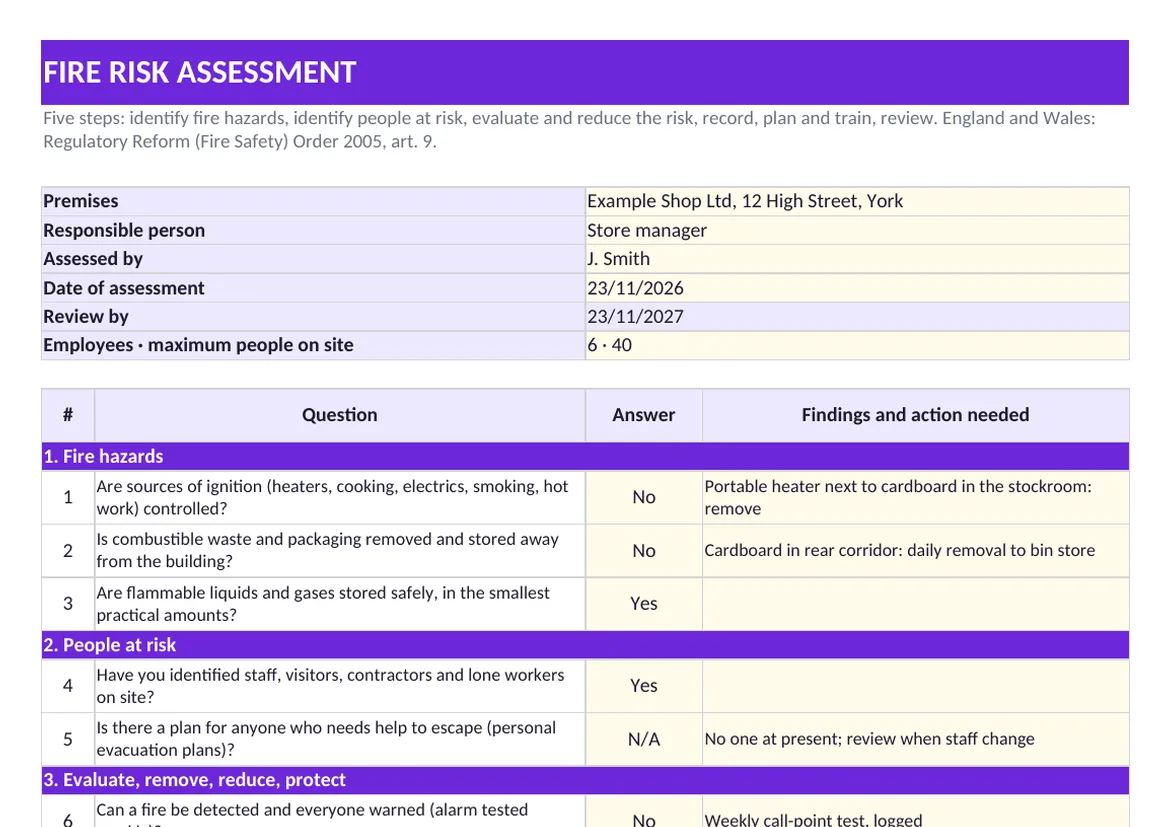
Who needs a fire risk assessment
Whoever controls business or other non-domestic premises (the employer, owner, landlord, occupier or managing agent) must carry out a suitable and sufficient fire risk assessment, review it regularly, and in England and Wales record its findings in writing. Article 9 of the Regulatory Reform (Fire Safety) Order 2005 sets the duty for the "responsible person". Since 1 October 2023, when the Building Safety Act 2022 changed article 9(6), every responsible person must record the assessment, not only employers with 5 or more employees.
| Nation | Law | When the findings must be written down |
|---|---|---|
| England and Wales | Regulatory Reform (Fire Safety) Order 2005, art. 9 | Always, as soon as practicable after the assessment or a review |
| Scotland | Fire (Scotland) Act 2005, ss.53 and 54; Fire Safety (Scotland) Regulations 2006, reg. 8 | With 5 or more employees, a licence or registration for the premises, or an alterations notice in force |
| Northern Ireland | Fire and Rescue Services (NI) Order 2006, arts. 25 and 26; Fire Safety Regulations (NI) 2010, reg. 8 | Same three triggers as Scotland |
Even where no written record is required, a written assessment is the simplest proof that you did one if the fire and rescue service inspects.
The five steps the template follows
- 1. Identify the fire hazards: sources of ignition (heaters, cooking, electrical equipment, smoking, hot work), sources of fuel (packaging, waste, furniture, flammable liquids) and sources of oxygen.
- 2. Identify people at risk: staff, visitors, contractors, lone workers, and people who need help to escape, such as wheelchair users or the elderly.
- 3. Evaluate, remove or reduce the risks: detection and warning, escape routes and exits, emergency lighting, signs, fire doors, firefighting equipment, safe storage of dangerous substances.
- 4. Record, plan and train: the findings and the measures taken, an emergency evacuation plan, information and training for staff.
- 5. Review: regularly, and after changes to the building, the work, the people or the stored materials, or after a fire or near miss.
These are the steps GOV.UK sets out for England and Wales. The record must include the findings, the measures taken or to be taken, and any group of people identified as especially at risk (article 9(7)); since 1 October 2023 that means all the findings, not only the significant ones. In Scotland and Northern Ireland the record covers the significant findings (regulation 9 of each set of regulations).
Fire risk assessment sample: a small shop with an office
| Area | Finding | Action | Owner and date |
|---|---|---|---|
| Ignition | Portable heater in the stockroom next to cardboard | Remove the heater; fixed heating only | Manager, 30/11/2026 |
| Fuel | Waste cardboard stored in the rear corridor | Daily removal to the external bin store 6 m from the building | Supervisor, daily |
| Escape | Rear fire exit partly blocked by deliveries | Keep 1 m clear; mark the floor; check at opening | Supervisor, daily |
| Warning | Fire alarm tested irregularly | Weekly call-point test, logged | Manager, every Monday |
| Equipment | Extinguishers last serviced 14 months ago | Book annual service; record the certificate | Manager, 15/12/2026 |
| People | Part-time staff not trained in evacuation | Induction training and one fire drill a year, recorded | Manager, 31/01/2027 |
The download has a five-step checklist filled in for this sample shop and an action plan with these six actions and an "Open actions" counter that updates as you mark items done. GOV.UK says to carry out at least one fire drill per year and record the results.
Doing it yourself or using a competent person
GOV.UK says you can carry out the fire risk assessment yourself with the help of the standard fire safety risk assessment guides, for example the guide for offices and shops. If you do not have the expertise or the time, you need to appoint a competent person, such as a professional risk assessor. The fire and rescue authority can advise but cannot do the assessment for you. Larger, complex or residential buildings usually need a specialist.
Enforcement and penalties
Fire and rescue authorities inspect premises and can issue alterations, enforcement or prohibition notices; a prohibition notice takes effect immediately. GOV.UK states that minor penalties can be up to £5,000 and major penalties can mean unlimited fines and up to 2 years in prison. In Scotland the Scottish Fire and Rescue Service enforces the rules, and in Northern Ireland the Northern Ireland Fire and Rescue Service.
General risk assessment and fire safety records in Draivix
A fire risk assessment sits alongside the general health and safety assessment; use the risk assessment template for other hazards. In Draivix, asset management records inspections with the outcome, certificate number and next inspection date, and puts maintenance with its next service date in the calendar, which suits extinguisher servicing and alarm or emergency lighting tests, and employee records track training with due dates. Draivix does not carry out or certify fire risk assessments.
Sources and legal basis
- legislation.gov.uk: Regulatory Reform (Fire Safety) Order 2005 (SI 2005/1541), article 9
- legislation.gov.uk: Fire (Scotland) Act 2005, section 53
- legislation.gov.uk: Fire (Scotland) Act 2005, section 54
- legislation.gov.uk: Fire Safety (Scotland) Regulations 2006 (SSI 2006/456)
- legislation.gov.uk: Fire Safety Regulations (Northern Ireland) 2010 (SR 2010/325)
- GOV.UK: Fire safety in the workplace
Facts checked:
02Frequently Asked Questions
Is a fire risk assessment a legal requirement?
Yes, for business and other non-domestic premises in every UK nation. In England and Wales the duty is in article 9 of the Regulatory Reform (Fire Safety) Order 2005.
Does a fire risk assessment have to be written down?
In England and Wales, yes, for every responsible person since 1 October 2023. In Scotland and Northern Ireland the record is required with 5 or more employees, a licence or registration, or an alterations notice.
Who is the responsible person for fire safety?
The employer, owner, landlord, occupier or anyone else with control of the premises, such as a facilities manager or managing agent. Where there are several, they must work together.
Can I do my own fire risk assessment?
Yes, GOV.UK says you can do it yourself using the standard guides. If you lack the expertise or time, appoint a competent person.
How often should a fire risk assessment be reviewed?
Regularly, and whenever there is reason to think it is no longer valid, such as building work, a new use of the premises or more staff. Many businesses review it at least once a year.
What should a fire risk assessment include?
The fire hazards, the people at risk, the precautions in place and needed, the emergency plan and training, and in the record the findings, the measures and any group especially at risk.
03More Free UK Tools
Related UK Calculators, Templates & Guides
- Cash flow forecast template UK: 12-month sampleFree 12-month cash flow forecast template with a filled UK sample: VAT paid a month and 7 days after the quarter, PAYE on the 22nd and corporation tax.Open
- Profit and loss template UK: sample P&L statementFree profit and loss template and sample P&L in the Companies Act Format 1 layout: turnover, gross profit, overheads, corporation tax and profit after tax.Open
- Employment contract template UK: written statementFree UK written statement of employment particulars with every item ERA 1996 section 1 requires, the day-one and 2-month deadlines and notice periods.Open
- E-invoicing UK 2029: rules, Peppol and timelineUK e-invoicing from 1 April 2029: VAT invoices between VAT-registered businesses go over Peppol. Timeline, scope, exemptions and a readiness checklist.Open
Let’s start together
Tell us how your business works.
We will show you what a system that takes over part of that work could look like.
Book a consultation