
01Free UK Online Calculator & Excel
Profit and loss template UK: sample P&L statement in the Companies Act format with corporation tax
Free profit and loss template and sample P&L in the Companies Act Format 1 layout: turnover, gross profit, overheads, corporation tax and profit after tax.
Corporation tax calculator with marginal relief
Uses the rates, limits and 3/200 fraction confirmed for financial years 2026 to 2028 in Budget 2026 (OOTLAR Annex A) and HMRC's CTM03925 formula; HMRC strictly pro-rates short periods by days, and ring fence profits, close investment holding companies and non-UK resident companies are excluded.
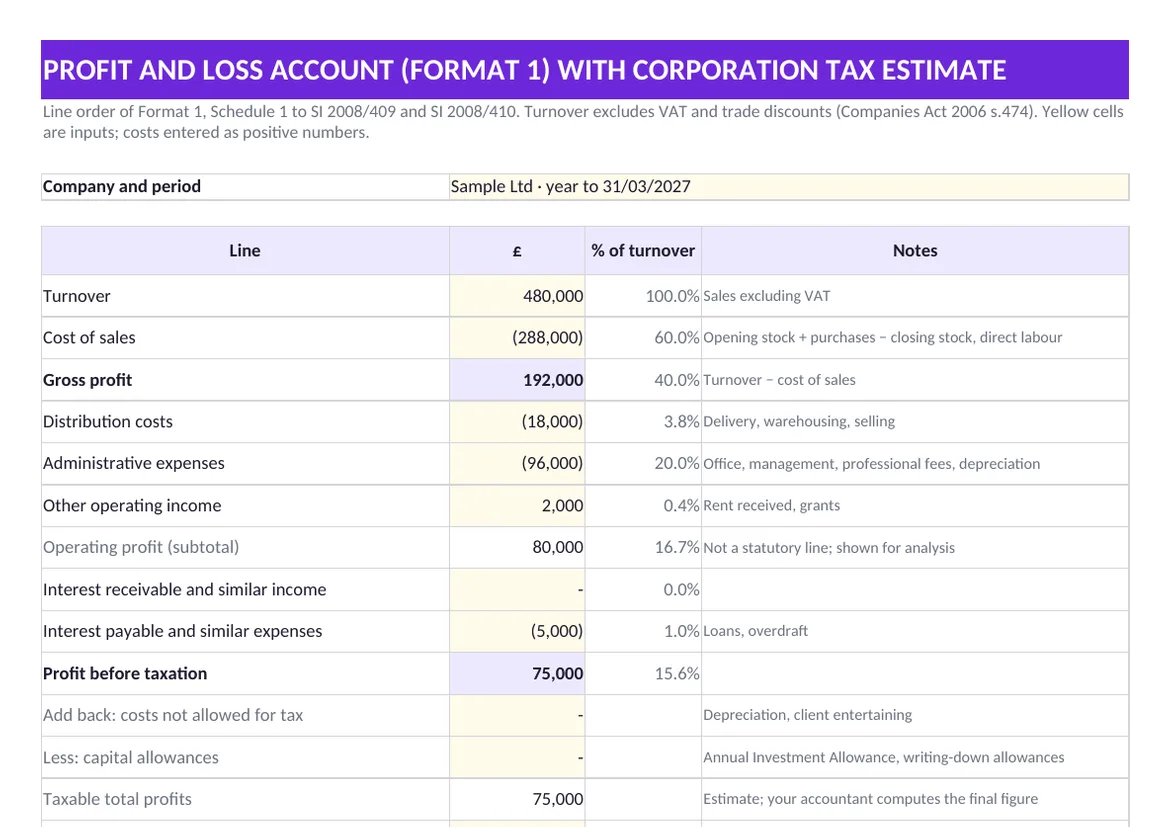
A sample profit and loss statement
A profit and loss account (P&L, or income statement) starts with turnover, takes off the cost of sales to give gross profit, then deducts overheads and interest to reach profit before tax, and finally corporation tax to leave profit for the year. UK company accounts follow the order of Format 1 in Schedule 1 to the accounts regulations, and the free template uses the same lines with formulas, so the sample below recalculates as you type your own figures.
| Sample Ltd, year to 31 March 2027 | £ | % of turnover |
|---|---|---|
| Turnover | 480,000 | 100.0% |
| Cost of sales | (288,000) | 60.0% |
| Gross profit | 192,000 | 40.0% |
| Distribution costs | (18,000) | 3.8% |
| Administrative expenses | (96,000) | 20.0% |
| Other operating income | 2,000 | 0.4% |
| Operating profit | 80,000 | 16.7% |
| Interest payable and similar expenses | (5,000) | 1.0% |
| Profit before taxation | 75,000 | 15.6% |
| Tax on profit (corporation tax estimate) | (16,125) | 3.4% |
| Profit for the financial year | 58,875 | 12.3% |
"Operating profit" is not one of the statutory Format 1 lines, but it is commonly shown as a subtotal before interest; the template shows it in grey so you can drop it from filed accounts.
What goes on each line
- Turnover: amounts from the provision of goods and services, after trade discounts, VAT and other taxes on those amounts (Companies Act 2006, section 474).
- Cost of sales: the direct cost of what was sold: opening stock plus purchases less closing stock, direct labour, subcontractors and carriage in.
- Distribution costs: delivery, warehousing after production, selling costs and sales staff.
- Administrative expenses: office rent and rates, directors' and office salaries, insurance, professional fees, IT, depreciation of office equipment.
- Other operating income: rent received, grants, royalties and other income outside normal trading.
- Interest payable: loan and overdraft interest. Interest received goes on its own line above it.
- Tax on profit: the corporation tax charge for the year (plus any deferred tax in full accounts).
Format 1 is set out in Schedule 1 to the Large and Medium-sized Companies and Groups (Accounts and Reports) Regulations 2008 (SI 2008/409); small companies use the same order under the Small Companies and Groups (Accounts and Directors' Report) Regulations 2008 (SI 2008/410).
Estimating the corporation tax
Corporation tax is charged on taxable total profits, which start from profit before tax but add back costs that are not allowed, such as depreciation and client entertaining, and deduct capital allowances instead. The template has two adjustment cells for this. For financial years 2026, 2027 and 2028 the rates are 19% on profits up to £50,000, 25% over £250,000, and 25% less marginal relief between. In the sample, £75,000 of taxable profit gives £18,750 at 25% less marginal relief of 3/200 × (£250,000 − £75,000) = £2,625, so £16,125, an effective 21.5%.
| Taxable profit | Corporation tax | Profit after tax |
|---|---|---|
| £40,000 | £7,600.00 | £32,400.00 |
| £75,000 | £16,125.00 | £58,875.00 |
| £100,000 | £22,750.00 | £77,250.00 |
| £300,000 | £75,000.00 | £225,000.00 |
The limits are divided by the number of associated companies plus one and pro-rated for a period shorter than 12 months; the calculator on this page and the template both handle associated companies. Corporation tax is the same in England, Scotland, Wales and Northern Ireland.
Deadlines and who needs a P&L
- Limited companies prepare annual accounts including a profit and loss account and file them with Companies House; a private company has 9 months after its financial year ends (21 months from registration for its first accounts), and the Company Tax Return is due 12 months after the period ends.
- Corporation tax is paid 9 months and 1 day after the end of the accounting period if taxable profits are up to £1.5 million.
- Sole traders and partnerships do not file accounts, but a P&L gives the profit figure for Self Assessment, where income tax and Class 4 NI apply instead of corporation tax.
- Lenders: GOV.UK says you need a business plan with financial forecasts to get a bank loan; pair the P&L with a cash flow forecast.
From margin to bottom line
Gross margin (gross profit ÷ turnover) shows pricing and buying; net margin (profit after tax ÷ turnover) shows everything else. In the sample they are 40.0% and 12.3%. Test single products with the profit margin calculator and the sales needed to cover overheads with the break-even calculator.
The P&L straight from your books in Draivix
In Draivix, general ledger accounting posts invoices, payments, stock and payroll records by posting rules and produces the trial balance, balance sheet and income statement (profit and loss) directly over the source documents. Invoicing and billing records each sale and its payment. Statutory accounts and the Company Tax Return are still prepared and filed by your accountant.
Sources and legal basis
- legislation.gov.uk: Large and Medium-sized Companies and Groups (Accounts and Reports) Regulations 2008 (SI 2008/409), Schedule 1
- legislation.gov.uk: Small Companies and Groups (Accounts and Directors' Report) Regulations 2008 (SI 2008/410), Schedule 1
- legislation.gov.uk: Companies Act 2006, section 474
- GOV.UK: Corporation Tax rates and reliefs
- HMRC: Corporation Tax marginal relief
- GOV.UK: Prepare and file annual accounts for a limited company
Facts checked:
02Frequently Asked Questions
What is a profit and loss statement?
A summary of a business's income and costs over a period, usually a year, ending with the profit or loss. It is also called a P&L, a profit and loss account or an income statement.
What goes in a profit and loss account?
In Format 1 order: turnover, cost of sales, gross profit, distribution costs, administrative expenses, other operating income, investment income, interest payable, tax on profit and profit for the year.
How do I calculate gross profit?
Turnover minus cost of sales. In the sample, £480,000 − £288,000 = £192,000, a 40% gross margin.
Does turnover include VAT?
No. Section 474 of the Companies Act 2006 defines turnover after trade discounts, VAT and other taxes on the amounts.
How do I estimate corporation tax from my P&L?
Adjust profit before tax for disallowed costs and capital allowances, then apply 19%, 25% or 25% less marginal relief. £75,000 of taxable profit gives £16,125.
Is a P&L the same as a cash flow statement?
No. The P&L matches income and costs to the period; a cash flow statement or forecast tracks money in and out of the bank, including VAT, loans and tax payments.
03More Free UK Tools
Related UK Calculators, Templates & Guides
- Employment contract template UK: written statementFree UK written statement of employment particulars with every item ERA 1996 section 1 requires, the day-one and 2-month deadlines and notice periods.Open
- E-invoicing UK 2029: rules, Peppol and timelineUK e-invoicing from 1 April 2029: VAT invoices between VAT-registered businesses go over Peppol. Timeline, scope, exemptions and a readiness checklist.Open
- Payslip template UK: free itemised pay statementFree UK payslip template in Excel and PDF with live totals: gross pay, hours, deductions and net pay as ERA 1996 s.8 requires, plus the Northern Ireland rules.Open
- Credit note template UK: free VAT credit noteFree UK VAT credit note template in Excel and PDF with every detail VAT Notice 700 (18.2.3) lists, live totals, and when the VAT adjustment goes on your return.Open
Let’s start together
Tell us how your business works.
We will show you what a system that takes over part of that work could look like.
Book a consultation