
01Free UK Online Calculator & Excel
Electrical installation condition report (EICR): landlord rules by nation, deadlines and a tracking register
What an EICR is, how often landlords need one in England, Wales, Scotland and Northern Ireland, the codes, the deadlines and a free register for every property.
EICR deadline calculator for landlords
Dates counted from the wording of each nation's regulations, read on legislation.gov.uk on 23 November 2026, for a home let as the tenant's only or main home; the report's own dates and any earlier deadline in it bind you, and a tenancy excluded by the regulations follows other rules.
What an EICR is, and what it is not
An electrical installation condition report (EICR) records the result of an inspection and test of a property's fixed electrical installation, carried out by a qualified person against the wiring regulations, BS 7671. It lists any defects with a code and says when the next inspection is due. People search for an "EICR certificate", but it is a report: a satisfactory one shows no C1, C2 or FI items, an unsatisfactory one needs work. A new installation or a full rewire gets an electrical installation certificate (EIC) instead, which the English guidance accepts as covering the first 5 years. The current wiring standard is BS 7671:2018+A4:2026, published on 15 April 2026; the version it replaced was withdrawn on 15 October 2026. The landlord regulations name the 18th edition, BS 7671:2018 (in Wales, BS 7671:2018+A2:2022).
| Code | Meaning | What the landlord must do |
|---|---|---|
| C1 | Danger present, risk of injury | Remedial work within the deadline (Scotland: immediately) |
| C2 | Potentially dangerous | Remedial work within the deadline (Scotland: urgently) |
| FI | Further investigation required without delay | Investigation within the deadline |
| C3 | Improvement recommended | Not required by the regulations |
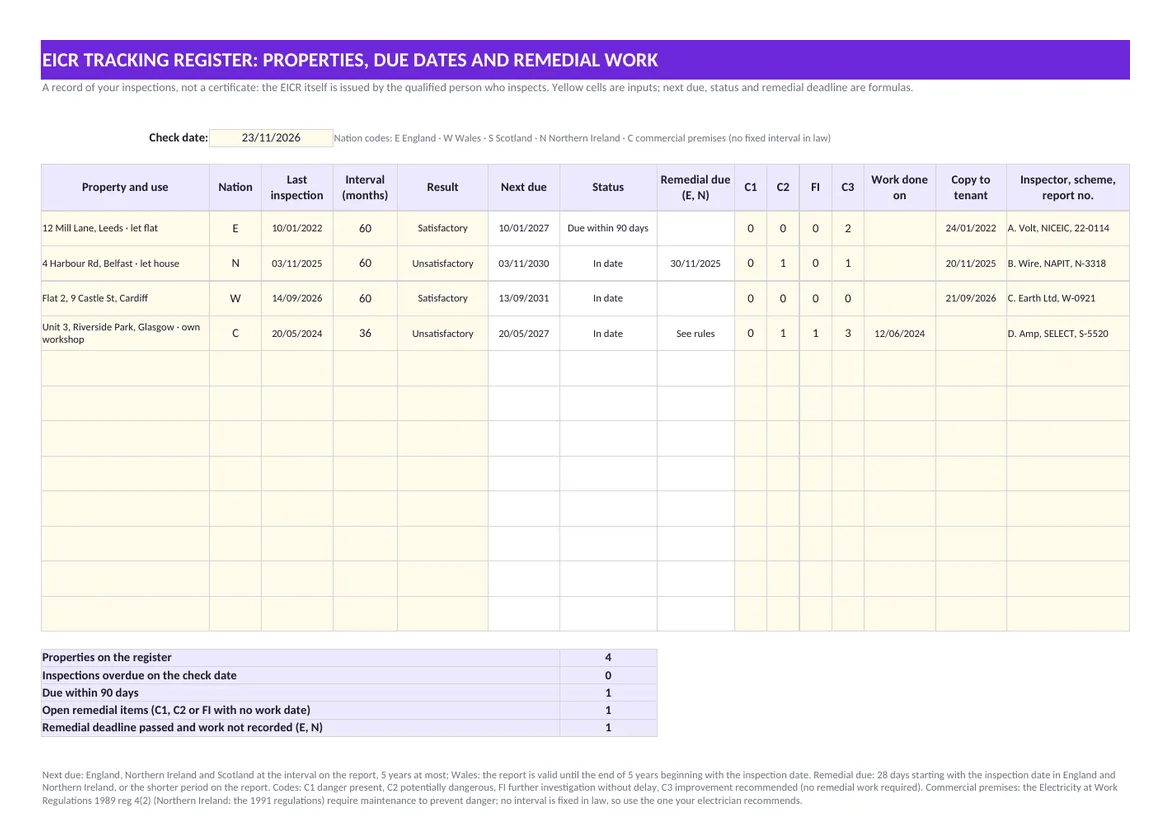
The free Excel register on this page is not a certificate or a report and cannot replace one. It is a log of your properties: the last inspection, the interval on the report, the next due date and its status on the date you choose, the codes found, the remedial deadline for England and Northern Ireland, and when the work and the tenant's copy were done. A second sheet sums up the rules by nation. The calculator above gives the dates for one inspection.
Rented homes: the rules in each nation
| Nation and law | How often | Copies | Remedial work |
|---|---|---|---|
| England: Electrical Safety Standards ... Regulations 2020 (SI 2020/312) | At least every 5 years, or sooner if the report says; before a new specified tenancy starts | Existing tenants within 28 days of the inspection; new tenants before they move in; the council within 7 days of a written request | Within 28 days starting with the date of the inspection, or the shorter period in the report; written confirmation to tenants and the council within 28 days of completing it |
| Wales: Renting Homes (Fitness for Human Habitation) (Wales) Regulations 2022, reg 6 | A valid report for every occupation; valid for 5 years beginning with the inspection date, or to the earlier date it gives | To the contract-holder within 14 days starting with the occupation date, or with the day an inspection during the occupation was completed | Written confirmation of the work within 14 days starting with the day the landlord received it |
| Scotland: Housing (Scotland) Act 2006, ss.19A and 19B | Before the tenancy (no more than 5 years earlier), then no more than 5 years apart | Tenant gets the latest record before the tenancy and a copy of any made during it; landlord keeps records 6 years | Repairing standard: C1 immediately, C2 urgently (statutory guidance) |
| Northern Ireland: Electrical Safety Standards for Private Tenancies Regulations (NI) 2024 | At least every 5 years; before a new tenancy; existing tenancies by 1 December 2025 | Existing tenants within 28 days beginning with the inspection day; the council within 7 days of a request | Within 28 days beginning with the inspection day, or sooner; confirmation within 28 days of completion |
England covers private and, since the 2025 amendment, social rented homes: a social tenancy granted before 1 December 2025 had to have its first inspection before 1 November 2026, and social landlords must also check electrical equipment they provide at least every 5 years. Some tenancies are excluded, among them lodgers living with the landlord, long leases of 7 years or more, student halls, hostels and refuges, care homes, hospitals and other healthcare accommodation. The regulations cover the installation in the home, not the communal areas. A council can impose a financial penalty of up to £40,000; the 2025 amendment raised it from £30,000 from 1 November 2025 (1 May 2026 for social tenancies granted before 1 December 2025). A tenant who refuses access does not put the landlord in breach if the landlord took all reasonable steps.
Wales goes further: while the landlord does not comply, the home is treated as unfit for human habitation, and the duty covers installations that serve the home in parts of the building the landlord controls. Scotland also requires a portable appliance test of the electrical appliances the landlord provides, at least every 5 years alongside the EICR; the inspector should be a member of SELECT, NICEIC or NAPIT, or meet the competence checklist in the guidance, and the tenant cannot be charged. Northern Ireland makes failing a duty an offence with a fine of up to level 5 on summary conviction.
Counting the deadlines correctly
The four laws count days in different ways, and a day matters. England's remedial deadline is 28 days "starting with" the inspection date, so for an inspection on Monday 1 March 2027 the work must be done by Sunday 28 March; the copy to existing tenants is due "within 28 days of" the inspection, so Monday 29 March. Northern Ireland counts both from the inspection day itself, so both fall on Sunday 28 March. In Wales the 5-year validity "beginning with" the inspection date ends on 29 February 2032 for a 1 March 2027 report. The calculator counts each nation by its own wording; the date the report itself gives always wins if it is earlier.
- The deadline runs from the inspection, not from the day the report arrives.
- A shorter period written on the report replaces the 28 days.
- In England a new statutory periodic tenancy is a new tenancy; a contractual periodic one is not, according to the government guidance.
- Keep the report until the next one is due and give a copy to the next inspector.
Business premises you occupy
Offices, shops, workshops and warehouses are not covered by the rented-home rules. In Great Britain the Electricity at Work Regulations 1989, regulation 4(2), require electrical systems to be maintained so as to prevent danger, so far as is reasonably practicable; Northern Ireland has its own Electricity at Work Regulations (Northern Ireland) 1991. The law sets no fixed interval; the HSE says installations should be tested often enough that there is little chance of deterioration leading to danger. Electricians usually take the interval from the IET's Guidance Note 3, which is guidance and not law, and write it on the report, and the register uses the interval you enter. A business that lets homes follows the landlord rules above for those properties as well.
Tracking inspections in Draivix
In Draivix asset management records each inspection with its outcome, certificate or report number and next inspection date, and tracks expiry dates on documents, calculating their status so you see which are valid and which need renewal. Preventive maintenance plans with a monthly interval and a checklist create the service order when it is due, which suits a 60-month cycle or the shorter one on the report. Draivix keeps the record; the inspection and the report still come from a qualified electrician.
Sources and legal basis
- legislation.gov.uk: Electrical Safety Standards in the Private Rented Sector and Social Rented Sector (England) Regulations 2020, regulation 3
- legislation.gov.uk: Electrical Safety Standards in the Private Rented Sector (England) (Amendment) (Extension to the Social Rented Sector) Regulations 2025
- GOV.UK: Electrical safety standards in the private and social rented sectors, guidance
- legislation.gov.uk: Renting Homes (Fitness for Human Habitation) (Wales) Regulations 2022, regulation 6
- legislation.gov.uk: Housing (Scotland) Act 2006, section 19A
- legislation.gov.uk: Housing (Scotland) Act 2006, section 19B
- Scottish Government: Repairing Standard statutory guidance for private landlords, electrical safety
- legislation.gov.uk: Electrical Safety Standards for Private Tenancies Regulations (Northern Ireland) 2024, regulation 3
- legislation.gov.uk: Electricity at Work Regulations 1989, regulation 4
- legislation.gov.uk: Electricity at Work Regulations (Northern Ireland) 1991, SR 1991/13 (PDF)
- BSI: BS 7671:2018+A4:2026, the latest amendment to the IET Wiring Regulations (15 April 2026)
- HSE: Electrical safety at work, frequently asked questions
Facts checked:
02Frequently Asked Questions
What is an electrical installation condition report?
A report by a qualified person on the condition of a property's fixed wiring, tested against BS 7671, with coded defects and the date of the next inspection.
Is an EICR a certificate?
No. It is a report that is either satisfactory or unsatisfactory. A new installation gets an electrical installation certificate (EIC). A template or register like ours is neither.
How often do landlords need an EICR?
At least every 5 years in England, Wales, Scotland and Northern Ireland, or sooner if the report says so, and a new tenancy needs a valid report in place when it starts.
How long do I have to fix C1 or C2 items?
In England and Northern Ireland 28 days counted from the inspection, or less if the report says. In Scotland C1 at once and C2 urgently. Wales sets no number of days for the work but treats the home as unfit while the landlord is not compliant.
Do commercial premises need an EICR every 5 years?
The law sets no fixed interval. The Electricity at Work Regulations 1989 (in Northern Ireland, the 1991 regulations) require maintenance to prevent danger; follow the interval on your report.
What is the fine for not having an EICR in England?
The council can impose a financial penalty of up to £40,000.
03More Free UK Tools
Related UK Calculators, Templates & Guides
- Xero Alternative for UK Companies: Fact ComparisonXero and Draivix side by side in a comparison table: MTD, payroll, stock, manufacturing, CRM, hosting and licences, each fact linked to the vendor's own page.Open
- QuickBooks Alternative UK: Fact Comparison TableQuickBooks Online and Draivix in a comparison table: HMRC filing, payroll add-on, stock, projects, AI, hosting and plans, sourced from Intuit's UK pages.Open
- Odoo Alternative UK: Fact Comparison TableOdoo and Draivix in a comparison table: apps, UK localisation for MTD VAT and CIS, payroll, hosting, Studio, partners and per-user plans, from Odoo's pages.Open
- NetSuite Alternative UK: Fact Comparison TableOracle NetSuite and Draivix in a comparison table: ERP and CRM scope, VAT and MTD, manufacturing, HR add-on, data centres and licences, from the UK site.Open
Let’s start together
Tell us how your business works.
We will show you what a system that takes over part of that work could look like.
Book a consultation