
01Free UK Template · Excel and PDF
Expenses claim form template UK: receipts, mileage at 55p and meal allowances with live totals
Free employee expenses claim form in Excel and PDF: receipted costs, mileage at 55p and 25p for 2026/27, HMRC benchmark meal allowances and live totals.
What goes on an expenses claim
An employer can repay employees' business costs without tax, National Insurance or reporting when the employee would be entitled to a tax deduction for them, for example travel to a temporary workplace, a hotel on a business trip or parking at a client's site. This exemption has applied since 6 April 2016, when dispensations ended (HMRC 480, chapter 2). It does not apply to payments under salary sacrifice. Mileage allowance payments have their own statutory exemption.
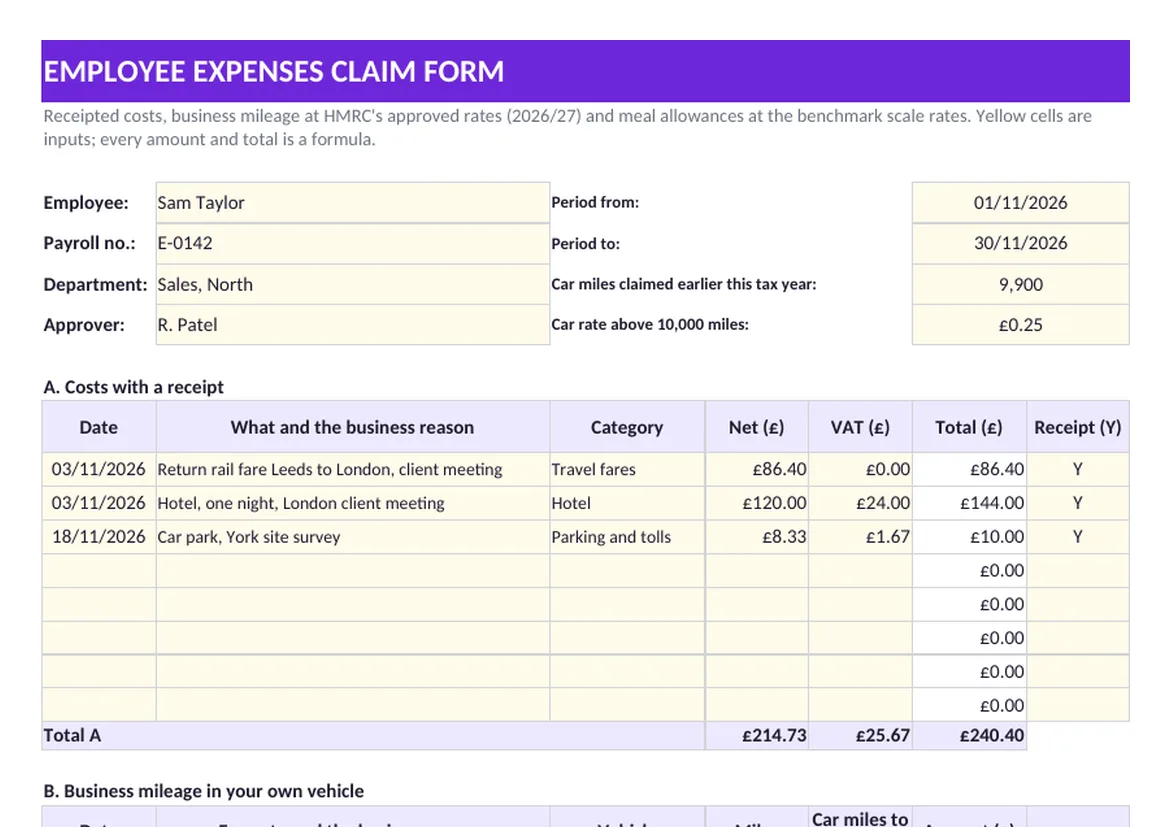
The form has three parts, each with its own subtotal, and a grand total, all live formulas:
- A. Costs with a receipt: date, what it was and the business reason, category, net, VAT and total, and a receipt tick.
- B. Business mileage in your own vehicle: journey, vehicle type and miles; the form counts car miles from the start of the tax year and applies 55p up to 10,000 miles and the rate you set above it.
- C. Meal allowances on qualifying journeys: hours travelled and whether the journey was still going at 8pm; the form shows the tax-free maximum and any taxable excess.
Mileage rates for 2026/27
| Vehicle | First 10,000 business miles in the tax year | Above 10,000 miles |
|---|---|---|
| Car or van | 55p | 25p |
| Motorcycle | 24p | 24p |
| Bicycle | 20p | 20p |
These are HMRC's approved mileage allowance payment rates from 6 April 2026; the car and van rate for the first 10,000 miles was 45p before. Budget 2026 announces 35p above 10,000 miles from 6 April 2027, which is an announcement as at 23 November 2026. Up to the approved amount (miles × rate) nothing is reported; anything the employer pays above it is added to pay and taxed. If the employer pays less, the employee can claim tax relief from HMRC on the part not paid. Commuting between home and a permanent workplace is not business travel. For a full trip log, use the HMRC mileage log and calculator.
Meal allowances at the benchmark scale rates
| Qualifying travel in the day | Maximum tax-free allowance |
|---|---|
| 5 hours or more | £5 |
| 10 hours or more | £10 |
| 15 hours or more and still travelling at 8pm | £25 |
| Extra, when the £5 or £10 allowance is paid and travel is still going at 8pm | up to £10 more |
These amounts are set by regulation 2 of the Income Tax (Approved Expenses) Regulations 2015 (SI 2015/1948), one allowance per day. Since 6 April 2019 employers do not need a system for checking receipts to pay these benchmark rates tax-free, but they must make sure the employee was on qualifying travel. Budget 2026 announces that the benchmark scale rates will be modernised from April 2028; as at 23 November 2026 the amounts above apply.
Worked example in the download
| Part | Detail | Amount |
|---|---|---|
| A. Receipts | Rail fare £86.40, hotel £120 + £24 VAT, parking £8.33 + £1.67 VAT | £240.40 |
| B. Mileage | 9,900 car miles already claimed: 60 miles at 55p = £33.00; 88 miles = 40 at 55p + 48 at 25p = £34.00; 6 bicycle miles at 20p = £1.20 | £68.20 |
| C. Meals | 16 hours to 8pm: £25; 11 hours: £10; 6 hours to 8pm: up to £15, £12 claimed | £47.00 |
| Amount due to the employee | No advance paid | £355.60 |
Change the car miles already claimed and the second trip moves across the 10,000-mile line differently; the subtotal and the grand total recalculate. The form is A4 with dates as dd/mm/yyyy.
When an employee claims from HMRC instead
- If the employer pays nothing or only part of a business cost, the employee can claim tax relief on the part not paid. Relief is at the employee's tax rate: a £60 claim at 20% is worth £12.
- Someone who completes a Self Assessment return claims on the return instead of through the online claim.
- Budget 2026 announces the removal of the £2,500 Self Assessment limit for employment expense claims from 6 April 2028.
Expenses and travel records in Draivix
Draivix does not calculate tax on expenses or process payroll. In employee records a travel order is built from individual trip segments and printed to PDF from a document template, so each claim has a trip and a purpose behind it. Cash repaid from the till is recorded as a cash disbursement voucher in the cash desk, and company vehicles keep a mileage log in asset management.
Sources and legal basis
- HMRC: Exemption for paid or reimbursed expenses (480, chapter 2)
- Income Tax (Approved Expenses) Regulations 2015, regulation 2
- HMRC: Travel, mileage and fuel rates and allowances
- GOV.UK: Expenses and benefits, business travel mileage
- GOV.UK: Claim tax relief for your job expenses
- HM Treasury: Budget 2026 (mileage rates, benchmark scale rates, employment expenses)
Facts checked:
02Frequently Asked Questions
What should an expenses claim form include?
The employee, the period, each cost with its date, business reason and receipt, business miles with the vehicle, meal allowances with hours travelled, totals, and signatures of the employee and the approver.
What is the HMRC mileage rate for 2026/27?
55p a mile for the first 10,000 business miles in a car or van, then 25p; 24p for motorcycles and 20p for bicycles.
How much meal allowance is tax-free?
£5 for 5 hours of qualifying travel, £10 for 10 hours, £25 for 15 hours still going at 8pm, plus up to £10 when the £5 or £10 rate is paid and travel continues past 8pm.
Do I need to report reimbursed expenses on a P11D?
Not if they are business costs the employee could claim a deduction for: since 6 April 2016 they are exempt and not reported. The exemption does not cover salary sacrifice.
Do I need receipts for meal allowances?
Not to pay benchmark scale rates tax-free since 6 April 2019, but the employer must make sure the travel qualified. Keep receipts for other costs.
Is the expenses claim form free?
Yes. Download the Excel or PDF version and use it as often as you like.
03More Free UK Tools
Related UK Calculators, Templates & Guides
- Autumn Budget 2026: what changes for employersWhen was the Budget 2026 and what changes for employers and small businesses: dates from January 2027 to 2029, figures and each measure's status in Parliament.Open
- Business rates calculator 2026/27 (England, Wales, Scotland)Estimate your 2026/27 business rates bill in England, Wales or Scotland from the rateable value, with the right multiplier and small business relief by nation.Open
- EICR: electrical installation condition report rulesWhat an EICR is, how often landlords need one in England, Wales, Scotland and Northern Ireland, the codes, the deadlines and a free register for every property.Open
- Xero Alternative for UK Companies: Fact ComparisonXero and Draivix side by side in a comparison table: MTD, payroll, stock, manufacturing, CRM, hosting and licences, each fact linked to the vendor's own page.Open
Let’s start together
Tell us how your business works.
We will show you what a system that takes over part of that work could look like.
Book a consultation