
01Free UK Template · Excel and PDF
Employment Rights Act 2025: what changes for employers and when, with a checklist
Employment Rights Act 2025 dates for employers: 6-month unfair dismissal rule from 1 January 2027, SSP, tribunals, fire and rehire, with a free checklist.
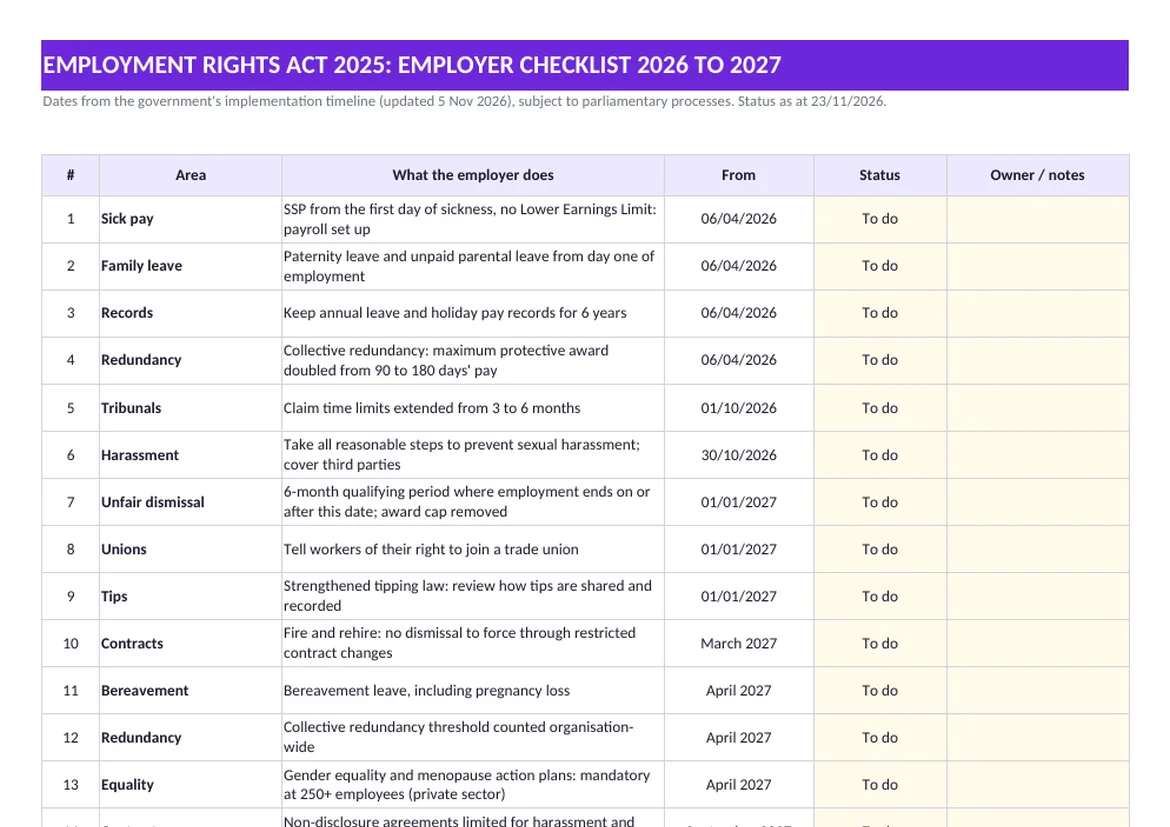
The dates employers need, as at 23 November 2026
From 1 January 2027 employees can claim unfair dismissal after 6 months' service instead of 2 years, where employment ends on or after that date, and the cap on the compensatory award goes. That is the next big change under the Employment Rights Act 2025, and the regulations bringing it in were made on 26 May 2026 (SI 2026/559). For the other measures, the government's timeline (updated 5 November 2026) says all future dates remain subject to parliamentary processes and may change.
| When | Change | Status |
|---|---|---|
| 18 Feb 2026 | Most of the Trade Union Act 2016 repealed; notice for day-one paternity and parental leave | In force |
| 6 Apr 2026 | Day-one paternity leave and unpaid parental leave; SSP from day one with no Lower Earnings Limit; maximum protective award doubled; whistleblowing on sexual harassment | In force |
| 7 Apr 2026 | Fair Work Agency set up | In force |
| 1 Oct 2026 | Employment tribunal time limit up from 3 to 6 months (Scottish contract claims from 9 Nov 2026) | In force |
| 30 Oct 2026 | "All reasonable steps" to prevent sexual harassment; duty not to permit third-party harassment; trade union access | In force |
| 1 Jan 2027 | Unfair dismissal after 6 months, compensatory award uncapped | Commencement made (SI 2026/559) |
| 1 Jan 2027 | Duty to tell workers of their right to join a union; tipping law strengthened | Planned |
| March 2027 | Fire and rehire protections | Planned |
| April 2027 | Bereavement leave including pregnancy loss; collective redundancy threshold counted organisation-wide; equality action plans mandatory for private and voluntary sector employers with 250 or more employees (public authorities from March 2027) | Planned |
| Sept 2027 | Regulations on NDAs in harassment and discrimination cases | Planned |
| Oct 2027 | Dismissal protection for pregnant women and new mothers; flexible working | Planned |
| Dec 2027 | Umbrella companies regulated | Planned |
| To be set | Zero hours: guaranteed hours, shift notice, pay for cancelled shifts | After consultation |
Unfair dismissal from 1 January 2027
Section 25 of the Act changes the qualifying period and removes the cap on the compensatory award. The Employment Rights Act 2025 (Commencement No. 4) Regulations 2026 (SI 2026/559) bring it into force on 1 January 2027. Under regulation 4 the new rules apply where the effective date of termination is on or after 1 January 2027, even if notice was given before then, and not where it falls earlier.
- Run probation reviews well inside the first 6 months, with written objectives and notes of each review.
- Use a fair procedure for any dismissal after 6 months: investigation, a hearing, the right to be accompanied and an appeal, as the Acas Code expects.
- Check contracts and handbooks that refer to the 2-year qualifying period.
- In Northern Ireland unfair dismissal still needs one year's continuous service; the Act's change does not extend there.
Changes already in force that payroll and HR must apply
- Statutory Sick Pay: since 6 April 2026 SSP is paid from the first day of sickness and there is no Lower Earnings Limit; it is the lower of £123.25 a week and 80% of average weekly earnings. See the SSP calculator.
- Family leave: paternity leave and unpaid parental leave are day-one rights.
- Holiday records: leave and holiday pay records must be kept for 6 years from 6 April 2026.
- Harassment: since 30 October 2026 employers must take all reasonable steps to prevent sexual harassment and must not permit harassment by third parties such as customers.
- Tribunals: employees now have 6 months to bring most claims, so disputes stay open longer.
Worked example: who gains unfair dismissal rights
| Employee started | Employment ends | Service | Can claim ordinary unfair dismissal? |
|---|---|---|---|
| 1 March 2026 | 15 December 2026 | 9 months | No: ends before 1 January 2027, under 2 years |
| 1 March 2026 | 15 January 2027 | 10 months | Yes: ends after 1 January 2027, over 6 months |
| 1 September 2026 | 15 January 2027 | 4 months | No: under 6 months |
| 1 March 2026, Belfast | 15 January 2027 | 10 months | No: Northern Ireland needs 1 year |
Automatically unfair reasons, such as whistleblowing or asserting a statutory right, need no qualifying service in any nation.
How to use the checklist
The download lists 18 actions with the date each applies from, a status column and an owner column. Mark each "Done" and the sheet counts your progress. Dates shown as a month are the government's plan and can move, so check the timeline before each one. It is a planning tool, not legal advice.
Draivix keeps the records these changes lean on: employee records hold each person's contract details, pay type and termination date, leave and absence management records leave requests and approvals, and time and attendance keeps the hours worked.
Sources and legal basis
- legislation.gov.uk: Employment Rights Act 2025 (c. 36)
- legislation.gov.uk: Employment Rights Act 2025, section 25
- legislation.gov.uk: Employment Rights Act 2025 (Commencement No. 4 and Transitional and Saving Provisions) Regulations 2026 (SI 2026/559)
- legislation.gov.uk: Employment Rights Act 2025, section 33 (equality action plans, 250 or more employees)
- GOV.UK: Plan to Make Work Pay and Employment Rights Act, timeline update (5 November 2026)
- Acas: Employment Rights Act 2025
- NI Direct: Being dismissed by your employer
Facts checked:
02Frequently Asked Questions
When does the 6-month unfair dismissal rule start?
On 1 January 2027. SI 2026/559, made on 26 May 2026, brings section 25 into force on that date for employment ending on or after it.
What are the main Employment Rights Act 2025 changes in 2026?
Day-one paternity and unpaid parental leave, SSP from day one without a Lower Earnings Limit, a 6-month tribunal time limit, a doubled protective award and a duty to take all reasonable steps against sexual harassment.
Does the Employment Rights Act 2025 apply in Northern Ireland?
Mostly not. Employment law is devolved to Northern Ireland, where unfair dismissal still needs one year's service. The SSP changes have separate NI sections in the Act.
When do the zero-hours changes come in?
No date yet. The government will set the timing for guaranteed hours, shift notice and pay for cancelled shifts after consultation.
When was the Employment Rights Act 2025 passed?
It received Royal Assent on 18 December 2025 as chapter 36 of 2025. Most measures come in later by commencement regulations.
Is fire and rehire banned?
The timeline plans fire and rehire protections for March 2027. Until they start, dismissing and re-engaging is judged under the existing unfair dismissal rules.
03More Free UK Tools
Related UK Calculators, Templates & Guides
- Corporation tax calculator UK with marginal reliefCalculate UK corporation tax: 19% up to £50,000, 25% over £250,000 and marginal relief between, with associated companies and short periods, HMRC examples.Open
- Dividend tax calculator UK 2026/27Dividend tax for 2026/27: £500 allowance, then 10.75%, 35.75% and 39.35%. Work out tax on salary plus dividends, with HMRC's example and the Scottish rule.Open
- Holiday pay calculator UK (12.07% and leavers)Work out UK holiday pay: a week's pay over 52 paid weeks, holiday pay owed on leaving and 12.07% rolled-up pay for irregular hours, with GOV.UK's example.Open
- Invoice template UK: free VAT invoice (Excel, PDF)Free UK invoice template in Excel and PDF with every detail VAT Notice 700 requires, VAT rounded as HMRC allows, plus what sole traders and companies must show.Open
Let’s start together
Tell us how your business works.
We will show you what a system that takes over part of that work could look like.
Book a consultation